
|
You entered: star
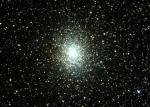 Globular Cluster M19
19.07.2000
M19 appears to be a typical globular cluster of stars - except for its shape. If one looks closely at the cluster, pictured above, it appears to be longer (top to bottom) than it is wide.
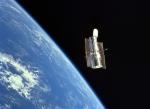 The Orbiting Hubble Space Telescope
6.08.2001
The Hubble Space Telescope (HST) is the largest orbiting public optical telescope in history. Its 2.4 meter diameter reflecting mirror and its perch above Earth's atmosphere allow it to create exceptionally sharp images.
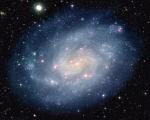 Spiral Galaxy NGC 300
21.08.2002
NGC 300 is so interesting because it is so normal. An Sc-type spiral galaxy in the nearby Sculptor group of galaxies, NGC 300 shows typical flowing blue spiral arms, an expected compact nucleus, and the requisite amount of stars, star clusters, and nebulae.
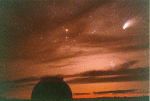 Sunset with Hale-Bopp at Keck
5.05.1997
A famous star cluster and observatory highlight this picture of Comet Hale-Bopp. Taken last week from the observatory summit of Hawaii's Mauna Kea Volcano, the dome of the new 10-meter Keck II telescope appears silhouetted on the lower left.
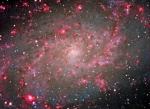 Hydrogen in M33
23.11.2006
Gorgeous spiral galaxy M33 seems to have more than its fair share of hydrogen. Its inner 30,000 light-years are shown here in an image processed to fully reveal the reddish glow of ionized hydrogen regions (HII regions) sprawling along loose spiral arms as they wind toward the galaxy's core.
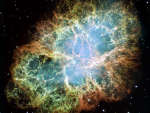 M1: The Crab Nebula from Hubble
17.02.2008
This is the mess that is left when a star explodes. The Crab Nebula, the result of a supernova seen in 1054 AD, is filled with mysterious filaments. The filaments are not only tremendously...
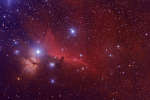 Orion s Horsehead Nebula
21.02.2008
The Horsehead Nebula is one of the most famous nebulae on the sky. It is visible as the dark indentation to the red emission nebula seen just below and left of center in the this photograph. The brightest star on the left is located in the belt of the familiar constellation Orion.
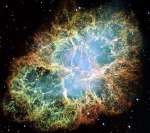 M1: The Crab Nebula from Hubble
25.10.2009
This is the mess that is left when a star explodes. The Crab Nebula, the result of a supernova seen in 1054 AD, is filled with mysterious filaments. The filaments are not only tremendously...
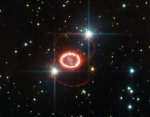 The Mysterious Rings of Supernova 1987A
26.02.2012
What's causing those odd rings in supernova 1987A? Twenty five years ago, in 1987, the brightest supernova in recent history was seen in the Large Magellanic Clouds. At the center of the above picture is an object central to the remains of the violent stellar explosion.
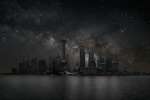 Darkened City
11.04.2013
In a haunting vista you can never see, bright stars and the central Milky Way rise over the dark skyline of metropolitan Pudong in Shanghai, China. Looking east across the Huangpu River, the cityscape includes Pudong's 470 meter tall Oriental Pearl Tower.
|
January February March April May June July August September October |
|||||||||||||||||||||||||||||||||||||||||||||||||