
|
You entered: star
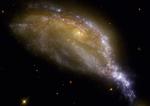 A Galaxy Collision in NGC 6745
2.11.2000
Galaxies don't normally look like this. NGC 6745 actually shows the results of two galaxies that have been colliding for only hundreds of millions of years. Just off the above photograph to the lower right is the smaller galaxy, moving away.
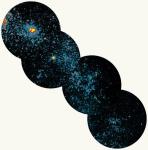 The UV SMC from UIT
24.03.2001
Translated from the "acronese" the title reads - The UltraViolet Small Magellanic Cloud from the Ultraviolet Imaging Telescope. FYI, the four ultraviolet images used in this mosaic of the nearby irregular galaxy known...
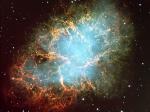 The Crab Nebula from VLT
14.07.2002
The Crab Nebula, filled with mysterious filaments, is the result of a star that was seen to explode in 1054 AD. This spectacular supernova explosion was recorded by Chinese and (quite probably) Anasazi Indian astronomers.
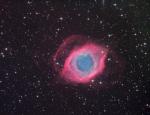 NGC 7293: The Helix Nebula
3.08.2007
A mere seven hundred light years from Earth, in the constellation Aquarius, a sun-like star is dying. Its last few thousand years have produced the Helix Nebula (NGC 7293), a well studied and nearby example of a Planetary Nebula, typical of this final phase of stellar evolution.
 The Average Color of the Universe
1.11.2009
What color is the universe? More precisely, if the entire sky was smeared out, what color would the final mix be? This whimsical question came up when trying to determine what stars are commonplace in nearby galaxies. The answer, depicted above, is a conditionally perceived shade of beige.
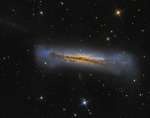 Edge on NGC 3628
4.11.2011
Sharp telescopic views of magnificent edge-on spiral galaxy NGC 3628 show a puffy galactic disk divided by dark dust lanes. The tantalizing scene puts many astronomers in mind of its popular moniker, The Hamburger Galaxy.
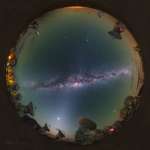 ALMA Milky Way
24.07.2014
This alluring all-skyscape was taken 5,100 meters above sea level, from the Chajnantor Plateau in the Chilean Andes. Viewed through the site's rarefied atmosphere at about 50% sea level pressure, the gorgeous Milky Way stretches through the scene.
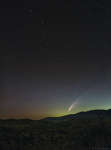 Finding NEOWISE
18.07.2020
If you can see the stars of the Big Dipper, you can find comet NEOWISE in your evening sky tonight. After sunset look for the naked-eye comet below the bowl of the famous celestial kitchen utensil of the north and above your northwestern horizon.
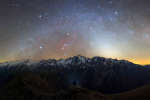 Zodiacal Night
10.04.2021
An intense band of zodiacal light is captured in this serene mountain and night skyscape from April 7. The panoramic view was recorded after three hours of hiking from a vantage looking west after sunset across the Pyrenees in southern France. At 2838 meters altitude, Mont Valier is the tallest peak near center.
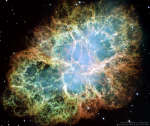 APOD: 2023 January 15 Б M1: The Crab Nebula from Hubble
15.01.2023
This is the mess that is left when a star explodes. The Crab Nebula, the result of a supernova seen in 1054 AD, is filled with mysterious filaments. The filaments are not only tremendously...
|
January February March April May June July August September October |
|||||||||||||||||||||||||||||||||||||||||||||||||