
|
You entered: star
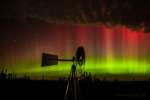 October Aurora in Prairie Skies
5.10.2013
Wind and spaceweather are transformed in this haunting night skyscape. The prairie windmill and colorful auroral display were captured on October 1, from central South Dakota, USA, as a good season for aurora hunters came with longer autumn nights.
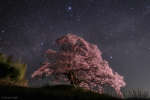 Summer Triangles over Japan
5.05.2015
Have you ever seen the Summer Triangle? The bright stars Vega, Deneb, and Altair form a large triangle on the sky that can be seen rising in the early northern early spring during the morning and rising in the northern fall during the evening.
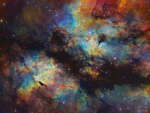 IC 1318: The Butterfly Nebula in Gas and Dust
15.03.2021
In the constellation of the swan near the nebula of the pelican lies the gas cloud of the butterfly next to a star known as the hen. That star, given the proper name Sadr...
 A December Winter Night
27.12.2024
Orion seems to come up sideways, climbing over a distant mountain range in this deep skyscape. The wintry scene was captured from southern Poland on the northern hemisphere's long solstice night. Otherwise unseen nebulae hang in the sky, revealed by the camera modified to record red hydrogen-alpha light.
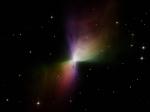 The Boomerang Nebula in Polarized Light
14.09.2005
Why did the Boomerang Nebula form? The symmetric cloud dubbed the Boomerang appears to have been created by a high-speed wind of gas and dust blowing from an aging central star at speeds of nearly 600,000 kilometers per hour.
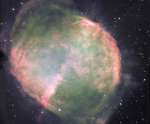 M27: Not A Comet
26.06.2008
Born on June 26th in 1730, astronomer Charles Messier scanned 18th century French skies for comets. To avoid confusion and aid his comet hunting, he diligently recorded this object as number 27 on his list of things which are definitely not comets.
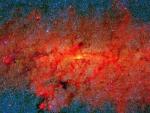 The Galactic Center Across the Infrared
7.07.2002
The center of our Galaxy is obscured in visible light by dark dust that rotates with the stars in the Galactic Plane. In this century, however, sensors have been developed that can detect light more red that humans can see - light called infrared.
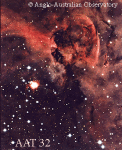 The Keyhole Nebula Near Eta Carinae
4.04.1996
The dark dusty Keyhole Nebula gets its name from its unusual shape. Designated NGC 3324, the Keyhole Nebula is a smaller region superposed on the bright Eta Carina Nebula. The Eta Carina Nebula...
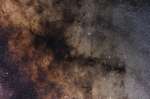 East of Antares
22.05.2009
East of Antares, dark markings sprawl through crowded star fields toward the center of our Milky Way Galaxy. Cataloged in the early 20th century by astronomer E. E. Barnard, the obscuring interstellar dust clouds include B59, B72, B77 and B78, seen in silhouette against the starry background.
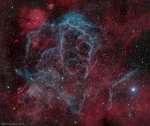 Vela Supernova Remnant
10.09.2010
The plane of our Milky Way Galaxy runs through this complex and beautiful skyscape. At the northwestern edge of the constellation Vela (the Sails) the four frame mosaic is over 10 degrees wide, centered on the glowing filaments of the Vela Supernova Remnant, the expanding debris cloud from the death explosion of a massive star.
|
January February March April May June July August September October |
|||||||||||||||||||||||||||||||||||||||||||||||||