
|
You entered: star
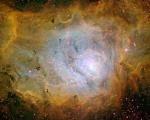 The Lagoon Nebula in Three Colors
20.08.2001
The bright Lagoon Nebula is home to a diverse array of astronomical objects. Particularly interesting sources include a bright open cluster of stars and several energetic star-forming regions. When viewed by eye, cluster light...
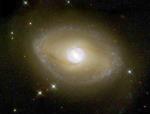 The Galactic Ring of NGC 6782
20.11.2001
Do spiral galaxies look the same in every color? NGC 6782 demonstrates colorfully that they do not. In visible light, NGC 6782 appears to be a normal spiral galaxy with a bright bar across its center.
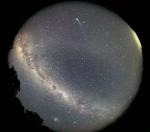 A Southern Sky View
9.03.2002
On 1996 March 22, a Galaxy and a comet shared the southern sky. They were captured together, from horizon to horizon, in the night sky above Loomberah, New South Wales, Australia by astronomer Gordon Garradd. Garradd used a home made all-sky camera with a fisheye lens, resulting in a circular 200 degree field of view.
 The Lagoon Nebula in Three Colors
6.10.2002
The bright Lagoon Nebula is home to a diverse array of astronomical objects. Particularly interesting sources include a bright open cluster of stars and several energetic star-forming regions. When viewed by eye, cluster light...
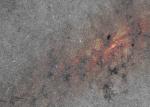 The Galactic Center in Infrared
7.09.2003
The center of our Galaxy is a busy place. In visible light, much of the Galactic Center is obscured by opaque dust. In infrared light, however, dust glows more and obscures less, allowing nearly one million stars to be recorded in the above photograph.
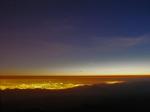 Three Planets from Mt Hamilton
30.06.2005
Venus, Mercury, and Saturn wandered close together in western evening skies last week. On Saturnday, June 25, astronomer R. Jay GaBany recorded this snapshot of their eye-catching planetary conjunction, from historic Lick Observatory on Mt. Hamilton, California, USA.
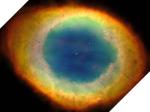 M57: The Ring Nebula
25.06.2006
It looked like a ring on the sky. Hundreds of years ago astronomers noticed a nebula with a most unusual shape. Now known as M57 or NGC 6720, the gas cloud became popularly known as the Ring Nebula.
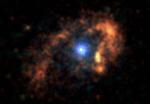 Eta Carinae in X Rays
11.10.1999
Eta Carinae is the one of the most luminous star systems in our Galaxy, radiating millions of times more power than our Sun. Eta Carinae is also one of the strangest star systems known, brightening and fading greatly since the early 1800s.
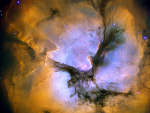 In the Center of the Trifid Nebula
30.06.2008
Clouds of glowing gas mingle with lanes of dark dust in the Trifid Nebula, a star forming region toward the constellation of Sagittarius. In the center, the three huge dark dust lanes that give the Trifid its name all come together.
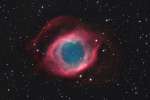 NGC 7293: The Helix Nebula
7.01.2011
A mere seven hundred light years from Earth, in the constellation Aquarius, a sun-like star is dying. Its last few thousand years have produced the Helix Nebula (NGC 7293), a well studied and nearby example of a Planetary Nebula, typical of this final phase of stellar evolution.
|
January February March April May June July August September October |
|||||||||||||||||||||||||||||||||||||||||||||||||