
|
You entered: star
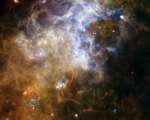 Herschel Views the Milky Way
16.10.2009
With a 3.5 meter diameter mirror, larger than the Hubble Space Telescope, Herschel is ESA's new infrared observatory. The space-based telescope is named for German-born British astronomer Frederick William Herschel who discovered infrared light over 200 years ago.
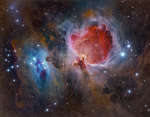 Great Orion Nebulae
13.09.2011
The Great Nebula in Orion, also known as M42, is one of the most famous nebulas in the sky. The star forming region's glowing gas clouds and hot young stars...
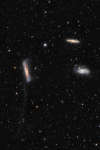 The Tidal Tail of NGC 3628
6.07.2012
A mere 30 million light-years away, large spiral galaxy NGC 3628 (center left) shares its neighborhood in the local Universe with two other large spirals, in a magnificent grouping otherwise known as the Leo Triplet.
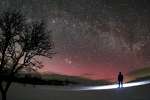 Comet of the North
5.04.2013
It looks like a double comet, but Comet PanSTARRS (C/2011 L4) is just offering skygazers a Messier moment. Outward bound and fading in this starry scene, the well-photographed comet is remarkably similar in brightness to M31, the Andromeda Galaxy.
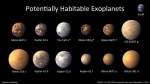 Habitable Worlds
3.03.2014
Is Earth the only known world that can support life? In an effort to find life-habitable worlds outside our Solar System, stars similar to our Sun are being monitored for slight light decreases that indicate eclipsing planets. Many previously-unknown planets are being found, including over 700 worlds recently uncovered by NASA's Kepler satellite.
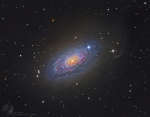 Messier 63: The Sunflower Galaxy
13.03.2014
A bright spiral galaxy of the northern sky, Messier 63 is about 25 million light-years distant in the loyal constellation Canes Venatici. Also cataloged as NGC 5055, the majestic island universe is nearly 100,000 light-years across. That's about the size of our own Milky Way Galaxy.
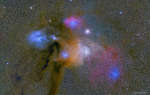 Colorful Clouds Near Rho Ophiuchi
5.07.2015
Why is the sky near Antares and Rho Ophiuchi so colorful? The colors result from a mixture of objects and processes. Fine dust illuminated from the front by starlight produces blue reflection nebulae. Gaseous clouds whose atoms are excited by ultraviolet starlight produce reddish emission nebulae. Backlit dust clouds block starlight and so appear dark.
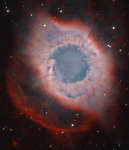 NGC 7293: The Helix Nebula
13.10.2021
A mere seven hundred light years from Earth, toward the constellation Aquarius, a sun-like star is dying. Its last few thousand years have produced the Helix Nebula (NGC 7293), a well studied and nearby example of a Planetary Nebula, typical of this final phase of stellar evolution.
 APOD: 2024 November 25 Б The Horsehead Nebula
24.11.2024
One of the most identifiable nebulas in the sky, the Horsehead Nebula in Orion, is part of a large, dark, molecular cloud. Also known as Barnard 33, the unusual shape was first discovered on a photographic plate in the late 1800s.
 APOD: 2024 December 1 Б Cosmic Latte: The Average Color of the Universe
30.11.2024
What color is the universe? More precisely, if the entire sky were smeared out, what color would the final mix be? This whimsical question came up when trying to determine what stars are commonplace in nearby galaxies. The answer, depicted here, is a conditionally perceived shade of beige. In computer parlance: #FFF8E7.
|
January February March April May June July August September October |
|||||||||||||||||||||||||||||||||||||||||||||||||