
|
You entered: star
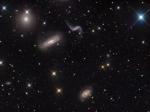 Galaxy Group Hickson 44
19.03.2007
Galaxies, like stars, frequently form groups. A group of galaxies is a system containing more than two galaxies but less than the tens or hundreds typically found in a cluster of galaxies. A most...
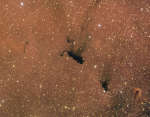 Molecular Cloud Barnard 163
1.05.2011
It may look to some like a duck, but it lays stars instead of eggs. In the center of the above image lies Barnard 163, a nebula of molecular gas and dust so thick that visible light can't shine through it.
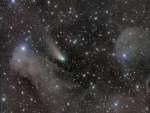 Outbound Comet ZTF
24.03.2023
Former darling of the northern sky Comet C/2022E3 (ZTF) has faded. During its closest approach to our fair planet in early February Comet ZTF was a mere 2.3 light-minutes distant. Then known as the green comet, this visitor from the remote Oort Cloud is now nearly 13.3 light-minutes away.
 NGC 1365: Majestic Island Universe
1.02.2024
Barred spiral galaxy NGC 1365 is truly a majestic island universe some 200,000 light-years across. Located a mere 60 million light-years away toward the faint but heated constellation Fornax, NGC 1365 is a dominant member of the well-studied Fornax Cluster of galaxies.
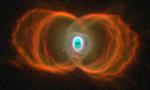 MyCn18: An Hourglass Nebula
4.06.2000
The sands of time are running out for the central star of this hourglass-shaped planetary nebula. With its nuclear fuel exhausted, this brief, spectacular, closing phase of a Sun-like star's life occurs as its outer layers are ejected - its core becoming a cooling, fading White Dwarf.
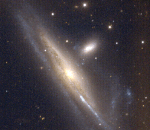 Interacting Galaxies
10.07.1998
This dramatic image of an interacting pair of galaxies was made using the 1.5 meter telescope at the Cerro Tololo Inter-American Observatory near La Serena, Chile. NGC 1531 is the background galaxy with a bright core just above center and NGC 1532 is the foreground spiral galaxy laced with dust lanes.
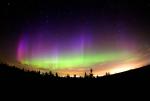 Northern Lights
30.07.2004
While enjoying the spaceweather on a gorgeous summer evening in mid-July, astronomer Philippe Moussette captured this colorful fish-eye lens view looking north from the Observatoire Mont Cosmos, Quebec, Canada, planet Earth. In the foreground, lights along the northern horizon give an orange cast to the low clouds.
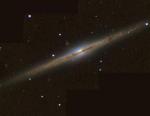 Edge On Spiral Galaxy NGC 891
20.12.1998
Is our Galaxy this thin? We believe so. The Milky Way, like NGC 891 pictured above, has the width of a typical spiral galaxy. Spirals have most of their bright stars, gas, and obscuring dust in a thin disk.
 The Galactic Center in Infrared
21.06.1999
The center of our Galaxy is a busy place. In visible light, much of the Galactic Center is obscured by opaque dust. In infrared light, however, dust glows more and obscures less, allowing nearly one million stars to be recorded in the above photograph.
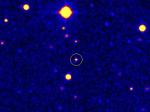 Mystery Object Explained
28.09.1999
Explorers often discover the unexpected. Such was the case when the Second Palomar Observatory Sky Survey chanced upon the unusual object circled in the above photograph. The so-called mystery object appeared star-like but displayed colors unlike most stars or quasars.
|
January February March April May June July August September October |
|||||||||||||||||||||||||||||||||||||||||||||||||