
|
You entered: star
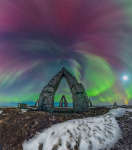 APOD: 2023 March 27 Б Aurora Over Arctic Henge
27.03.2023
Reports of powerful solar flares started a seven-hour quest north to capture modern monuments against an aurora-filled sky. The peaks of iconic Arctic Henge in Raufarhцfn in northern Iceland were already aligned with the stars: some are lined up toward the exact north from one side and toward exact south from the other.
 APOD: 2024 May 21 Б CG4: The Globule and the Galaxy
21.05.2024
Can a gas cloud eat a galaxy? It's not even close. The "claw" of this odd looking "creature" in the featured photo is a gas cloud known as a cometary globule. This globule, however, has ruptured. Cometary globules are typically characterized by dusty heads and elongated tails.
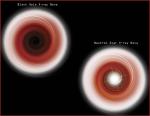 Black Holes Are Black
19.01.2001
Q: Why are black holes black? A: Because they have an event horizon. The event horizon is that one-way boundary predicted by general relativity beyond which nothing, not even light, can return. X-ray astronomers...
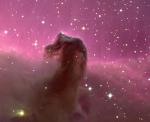 The Horsehead Nebula
19.05.1999
One of the most identifiable nebulae in the sky, the Horsehead Nebula in Orion, is part of a large, dark, molecular cloud. Also known as Barnard 33, the unusual shape was first discovered on a photographic plate in the late 1800s.
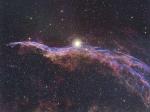 NGC 6960: The Witchs Broom Nebula
2.03.2004
Ten thousand years ago, before the dawn of recorded human history, a new light must suddenly have appeared in the night sky and faded after a few weeks. Today we know this light was an exploding star and record the colorful expanding cloud as the Veil Nebula.
 Look West for a NEAT Comet
7.05.2004
On May 5th, while scanning western skies after sunset, astronomer Jimmy Westlake was glad to spot a visitor from the outer solar system, Comet NEAT, with his own eyes. Taken with a normal lens...
 Central Cygnus Skyscape
19.08.2015
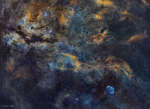
In cosmic brush strokes of glowing hydrogen gas, this beautiful skyscape unfolds across the plane of our Milky Way Galaxy and the center of the northern constellation Cygnus the Swan. The featured image spans about six degrees.
 The Elephants Trunk in IC 1396
13.10.2015
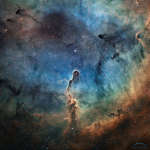
Like an illustration in a galactic Just So Story, the Elephant's Trunk Nebula winds through the emission nebula and young star cluster complex IC 1396, in the high and far off constellation of Cepheus. Of course, the cosmic elephant's trunk is over 20 light-years long.
 A Zodiacal Sky over Horseshoe Bend
22.05.2017
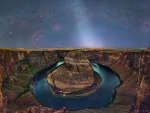
What's causing the unusual ray of white light extending upward from the central horizon? Dust orbiting the Sun. At certain times of the year, a band of sun-reflecting dust from the inner Solar System rises prominently before sunrise and is called zodiacal light.
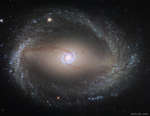 Spiral Galaxy NGC 1512: The Inner Ring
7.08.2017
Most galaxies don't have any rings -- why does this galaxy have two? To begin, the bright band near NGC 1512's center is a nuclear ring, a ring that surrounds the galaxy center and glows brightly with recently formed stars.
|
January February March April May June July August September October |
|||||||||||||||||||||||||||||||||||||||||||||||||