
|
You entered: star
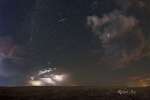 Perseid Storm
21.08.2010
Storms on the distant horizon and comet dust raining through the heavens above are combined in this alluring nightscape. The scene was recorded in the early hours of August 13 from the Keota Star Party site on the Pawnee National Grasslands of northeastern Colorado, USA.
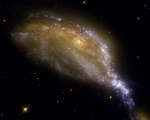 A Galaxy Collision in NGC 6745
30.09.2012
Galaxies don't normally look like this. NGC 6745 actually shows the results of two galaxies that have been colliding for only hundreds of millions of years. Just off the above digitally sharpened photograph to the lower right is the smaller galaxy, moving away.
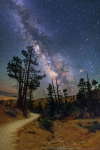 The Milky Trail
1.06.2013
Have you ever hiked the Queen's Garden trail in Bryce Canyon, Utah, USA, planet Earth? Walking along that path in this dark night skyscape, you can almost imagine your journey continues along the pale, luminous Milky Way.
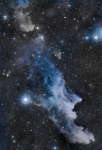 The Witch Head Nebula
30.10.2015
Double, double toil and trouble; Fire burn, and cauldron bubble .... maybe Macbeth should have consulted the Witch Head Nebula. A suggestively shaped reflection nebula, this cosmic crone is about 800 light-years away though. Its frightening visage seems to glare toward nearby bright star Rigel in Orion, just off the right edge of this frame.
 Luminous Salar de Uyuni
15.04.2017
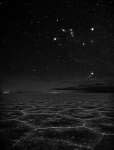
A scene in high contrast this thoughtful night skyscape is a modern composition inspired by M. C. Escher's lithograph Phosphorescent Sea. In it, bright familiar stars of Orion the Hunter and Aldebaran, eye of Taurus the Bull, hang in clear dark skies above a distant horizon.
 The Horsehead Nebula
17.12.2019
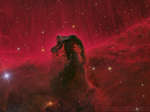
Sculpted by stellar winds and radiation, a magnificent interstellar dust cloud by chance has assumed this recognizable shape. Fittingly named the Horsehead Nebula, it is some 1,500 light-years distant, embedded in the vast Orion cloud complex.
 Galactic Cirrus: Mandel Wilson 9
21.07.2023
The combined light of stars along the Milky Way are reflected by these cosmic dust clouds that soar 300 light-years or so above the plane of our galaxy. Known to some as integrated flux nebulae and commonly found at high galactic latitudes, the dusty galactic cirrus clouds are faint.
 Quadrantids of the North
11.01.2024
Named for a forgotten constellation, the Quadrantid Meteor Shower puts on an annual show for planet Earth's northern hemisphere skygazers. The shower's radiant on the sky lies within the old, astronomically obsolete constellation Quadrans Muralis.
 Venus On The Horizon
14.10.1997
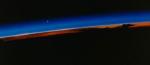
The month of October features a sky full of planets, including Venus as the brilliant evening star. Besides the sun and moon, Venus is the brightest object visible in Earth's sky. This month, Venus appears in early evening near the red planet Mars and Mars' red giant rival Antares above the southwestern horizon.
 NGC 6960: The Witch's Broom Nebula
23.08.2000
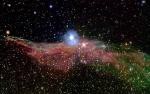
Ten thousand years ago, before the dawn of recorded human history, a new light must suddenly have appeared in the night sky and faded after a few weeks. Today we know this light was an exploding star and record the colorful expanding cloud as the Veil Nebula.
|
January February March April May June July August September October |
|||||||||||||||||||||||||||||||||||||||||||||||||