
|
You entered: star
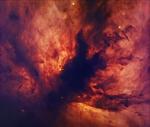 Flame Nebula Close Up
2.02.2007
Of course, the Flame Nebula is not on fire. Also known as NGC 2024, the nebula's suggestive reddish color is due to the glow of hydrogen atoms at the edge of the giant Orion molecular cloud complex some 1,500 light-years away.
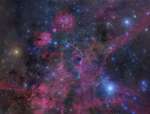 Vela Supernova Remnant
6.03.2008
The plane of our Milky Way Galaxy runs through this complex and beautiful skyscape. At the northwestern edge of the constellation Vela (the Sails) the 16 degree wide, 30 frame mosaic is centered on the glowing filaments of the Vela Supernova Remnant, the expanding debris cloud from the death explosion of a massive star.
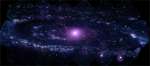 Ultraviolet Andromeda
27.10.2010
This stunning vista represents the highest resolution image ever made of the Andromeda Galaxy (aka M31) at ultraviolet wavelengths. Recorded by NASA's Swift satellite, the mosaic is composed of 330 individual images covering a region 200,000 light-years wide.
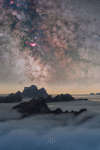 Clouds of Earth and Sky
24.07.2018
If you go high enough, you may find yourself on a picturesque perch between the water clouds of the Earth and the star clouds of the Milky Way. Such was the case last month for one adventurous alpinist astrophotographer.
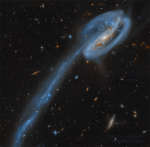 APOD: 2024 July 15 Б The Tadpole Galaxy from Hubble
15.07.2024
Why does this galaxy have such a long tail? In this stunning vista, based on image data from the Hubble Legacy Archive, distant galaxies form a dramatic backdrop for disrupted spiral galaxy Arp 188, the Tadpole Galaxy. The cosmic tadpole is a mere 420 million light-years distant toward the northern constellation of the Dragon (Draco).
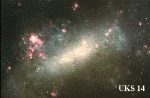 The Large Cloud of Magellan (LMC)
23.10.1996
Magellan and his crew had plenty of time to study the southern sky during their famous voyage around the world. As a result, two fuzzy cloud like objects in the southern sky are now known as the Clouds of Magellan. These star clouds are small irregular galaxies, satellites of our larger Milky Way spiral galaxy.
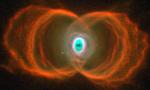 MyCn18: An Hourglass Nebula
14.09.1997
The sands of time are running out for the central star of this hourglass-shaped planetary nebula. With its nuclear fuel exhausted, this brief, spectacular, closing phase of a Sun-like star's life occurs as its outer layers are ejected - its core becoming a cooling, fading white dwarf.
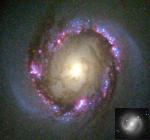 NGC 4314: A Nuclear Starburst Ring
15.06.1998
Is this old galaxy up to new tricks? The barred spiral galaxy NGC 4314 is billions of years old, but its appearance has changed markedly over just the past few millions of years. During that time, a nuclear ring of bright young stars has been evolving.
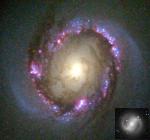 NGC 4314: A Nuclear Starburst Ring
12.12.1999
Is this old galaxy up to new tricks? The barred spiral galaxy NGC 4314 is billions of years old, but its appearance has changed markedly over just the past few millions of years. During that time, a nuclear ring of bright young stars has been evolving.
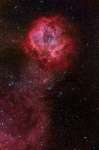 Long Stem Rosette
14.02.2008
The Rosette Nebula (aka NGC 2237) is not the only cosmic cloud of gas and dust to evoke the imagery of flowers. But it is the one most often suggested as a suitable astronomy image for Valentine's Day.
|
January February March April May June July August September October |
|||||||||||||||||||||||||||||||||||||||||||||||||