
|
You entered: star
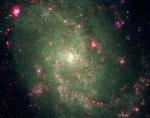 Elements of Nearby Spiral M33
27.09.2001
Spiral galaxy M33 is a mid-sized member of our Local Group of Galaxies. M33 is also called the Triangulum Galaxy for the constellation in which it resides. About four times smaller (in radius) than...
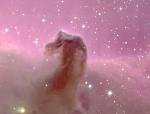 The Horsehead Nebula
16.12.2001
One of the most identifiable nebulae in the sky, the Horsehead Nebula in Orion, is part of a large, dark, molecular cloud. Also known as Barnard 33, the unusual shape was first discovered on a photographic plate in the late 1800s.
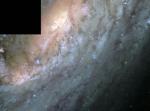 Barred Spiral Galaxy NGC 2903
21.03.2001
NGC 2903 is a spiral galaxy similar to our own Milky Way Galaxy. Similarities include its general size and a central bar. One striking difference, however, is the appearance of mysterious hot spots in NGC 2903's core. Upon
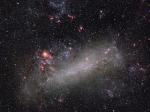 The Large Cloud of Magellan
10.05.2006
Portuguese navigator Fernando de Magellan and his crew had plenty of time to study the southern sky during the first circumnavigation of planet Earth. As a result, two fuzzy cloud-like objects easily visible for southern hemisphere skygazers are known as the Clouds of Magellan.
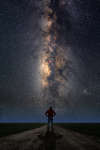 The Milky Road
13.06.2009
Inspired by the night skies of planet Earth in the International Year of Astronomy, photographer Larry Landolfi created this tantalizing fantasy view. The composited image suggests a luminous Milky Way is the heavenly extension of a country road.
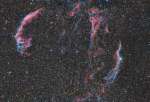 Wisps of the Veil Nebula
26.11.2012
Wisps like this are all that remain visible of a Milky Way star. About 9,000 years ago that star exploded in a supernova leaving the Veil Nebula, also known as the Cygnus Loop.
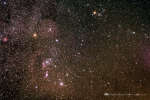 The Hunter, the Bull, and Lovejoy
13.01.2015
Heading north, Comet Lovejoy (C/2014 Q2) is putting on its best show for comet watchers now, with moonlight absent from mid-January's early evening skies. An easy binocular target and just visible to the unaided eye from dark sites, the comet sweeps across the constellation Taurus the Bull in this deep night skyscape.
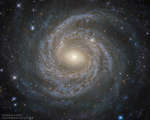 APOD: 2020 August 16 Б NGC 6814: Grand Design Spiral Galaxy from Hubble
16.08.2020
In the center of this serene stellar swirl is likely a harrowing black-hole beast. The surrounding swirl sweeps around billions of stars which are highlighted by the brightest and bluest. The breadth and beauty of the display give the swirl the designation of a grand design spiral galaxy.
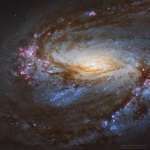 Messier 66 Close Up
28.01.2021
Big, beautiful spiral galaxy Messier 66 lies a mere 35 million light-years away. The gorgeous island universe is about 100 thousand light-years across, similar in size to the Milky Way. This reprocessed Hubble Space Telescope close-up view spans a region about 30,000 light-years wide around the galactic core.
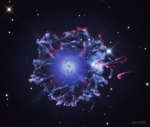 Halo of the Cats Eye
3.08.2022
What created the unusual halo around the Cat's Eye nebula? No one is sure. What is sure is that the Cat's Eye Nebula (NGC 6543) is one of the best known planetary nebulae on the sky.
|
January February March April May June July August September October |
|||||||||||||||||||||||||||||||||||||||||||||||||