
|
You entered: star
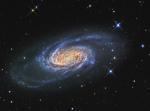 Bright Galaxy NGC 2903
6.07.2007
Spiral galaxy NGC 2903 is only some 20 million light-years distant in the constellation Leo. One of the brighter galaxies visible from the northern hemisphere, it is surprisingly missing from Charles Messier's famous catalog of celestial sights. This impressively sharp color image shows off the galaxy's beautiful blue spiral arms.
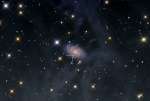 Art and Science in NGC 981
12.11.2009
This beautiful telescopic skyscape features spiral galaxy NGC 981. The island universe is about 50,000 light-years across and lies some 60 million light-years away toward the constellation Aries. An artistic presentation, the image...
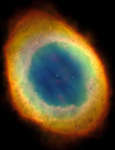 M57: The Ring Nebula
15.11.2009
It looks like a ring on the sky. Hundreds of years ago astronomers noticed a nebula with a most unusual shape. Now known as M57 or NGC 6720, the gas cloud became popularly known as the Ring Nebula.
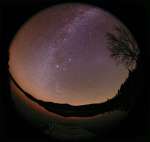 Zodiacal Light and Milky Way
20.10.2012
Ghostly apparitions of two fundamental planes in planet Earth's sky span this October all-sky view. The scene was captured from a lakeside campsite under dark skies in northern Maine, USA. In it, the plane of our Milky Way Galaxy arcs above faint airglow along the horizon.
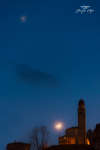 Venus and the Da Vinci Glow
25.03.2023
On March 23 early evening skygazers could watch Venus and a young crescent moon, both near the western horizon. On that date Earth's brilliant evening star, faint lunar night side and slender sunlit crescent were captured in this telephoto skyscape posing alongside a church tower from Danta di Cadore, Dolomiti, Italy.
 APOD: 2023 December 13 Б Deep Field: The Heart Nebula
13.12.2023
What excites the Heart Nebula? First, the large emission nebula on the left, catalogued as IC 1805, looks somewhat like a human heart. The nebula glows brightly in red light emitted by its most prominent element, hydrogen, but this long-exposure image was also blended with light emitted by silicon (yellow) and oxygen (blue).
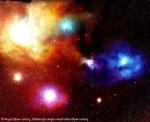 Antares and Rho Ophiuchi
21.05.2000
Why is the sky near Antares and Rho Ophiuchi so colorful? The colors result from a mixture of objects and processes. Fine dust illuminated from the front by starlight produces blue reflection nebulae. Gaseous clouds whose atoms are excited by ultraviolet starlight produce reddish emission nebulae. Backlit dust clouds block starlight and so appear dark.
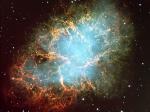 The Crab Nebula from VLT
14.09.2003
The Crab Nebula, filled with mysterious filaments, is the result of a star that was seen to explode in 1054 AD. This spectacular supernova explosion was recorded by Chinese and (quite probably) Anasazi Indian astronomers.
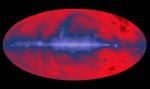 The Radio Sky: Tuned to 408MHz
5.02.2005
Tune your radio telescope to 408MHz (408 million cycles per second) and check out the Radio Sky! In the 1970s large dish antennas at three radio observatories, Jodrell Bank, MPIfR, and Parkes Observatory, were used to do just that - the data were combined to map the entire sky.
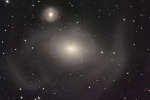 NGC 1316: After Galaxies Collide
2.09.2008
Astronomers turn detectives when trying to figure out the cause of startling sights like NGC 1316. Their investigation indicates that NGC 1316 is an enormous elliptical galaxy that started, about 100 million years ago, to devour a smaller spiral galaxy neighbor, NGC 1317, just above it.
|
January February March April May June July August September October |
|||||||||||||||||||||||||||||||||||||||||||||||||