
|
You entered: ultraviolet
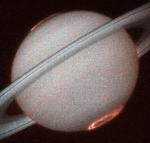 Saturnian Aurora
9.01.1998
Girdling the second largest planet in the Solar System, Saturn's Rings are one of the most spectacular sights for earthbound telescopes. This recently released image, from the orbiting Hubble Space Telescope's STIS instrument, offers a striking view of another kind of ring around Saturn - pole encircling rings of ultraviolet aurora.
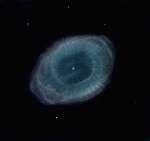 Ring Nebula Drawn
15.09.2012
A planetary nebula with a simple symmetry familiar to telescopic sky gazers, the Ring Nebula (M57) is some 2,000 light-years away in the musical constellation Lyra. Hints of changing colors and subtle details are brought out in this remarkable sketch of the cosmic ring.
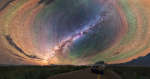 Colorful Airglow Bands Surround Milky Way
6.03.2018
Why would the sky glow like a giant repeating rainbow? Airglow. Now air glows all of the time, but it is usually hard to see. A disturbance however -- like an approaching storm -- may cause noticeable rippling in the Earth's atmosphere.
 Hydrogen Clouds of M33
13.10.2023
Gorgeous spiral galaxy Messier 33 seems to have more than its fair share of glowing hydrogen gas. A prominent member of the local group of galaxies, M33 is also known as the Triangulum Galaxy and lies a mere 3 million light-years away.
 APOD: 2024 January 28 Б Pluto in True Color
28.01.2024
What color is Pluto, really? It took some effort to figure out. Even given all of the images sent back to Earth when the robotic New Horizons spacecraft sped past Pluto in 2015, processing these multi-spectral frames to approximate what the human eye would see was challenging.
 APOD: 2025 June 8 Б Facing NGC 3344
8.06.2025
From our vantage point in the Milky Way Galaxy, we see NGC 3344 face-on. Nearly 40,000 light-years across, the big, beautiful spiral galaxy is located just 20 million light-years away in the constellation of Leo Minor. This multi-color Hubble Space Telescope close-up of NGC 3344 includes remarkable details from near infrared to ultraviolet wavelengths.
 APOD: 2024 August 18 Б A Solar Prominence Eruption from SDO
18.08.2024
One of the most spectacular solar sights is an erupting prominence. In 2011, NASA's Sun-orbiting Solar Dynamic Observatory spacecraft imaged an impressively large prominence erupting from the surface. The dramatic explosion was captured in ultraviolet light in the featured time lapse video covering 90 minutes, where a new frame was taken every 24 seconds.
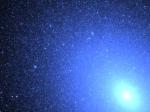 M32: Blue Stars in an Elliptical Galaxy
3.11.1999
Elliptical galaxies are known for their old, red stars. But is this old elliptical up to new tricks? In recent years, the centers of elliptical galaxies have been found to emit unexpectedly high amounts of blue and ultraviolet light.
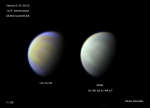 Multicolor Venus
1.03.2012
Brilliant Venus now shines in western skies at twilight. Seen as the prominent evening star, the planet is a tantalizing celestial beacon even for casual skygazers. Venus can offer less than satisfying telescopic views though. The planet is shrouded in reflective clouds that appear bright but featureless at the eyepiece.
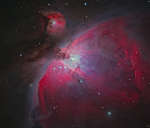 At the Heart of Orion
12.03.2017
Near the center of this sharp cosmic portrait, at the heart of the Orion Nebula, are four hot, massive stars known as the Trapezium. Tightly gathered within a region about 1.5 light-years in radius, they dominate the core of the dense Orion Nebula Star Cluster.
|
January February March April May June July August September October |
|||||||||||||||||||||||||||||||||||||||||||||||||