
|
You entered: ultraviolet
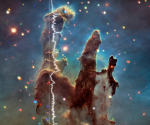 Sonified: Eagle Nebula Pillars
30.09.2020
Yes, but have you ever experienced the Eagle Nebula with your ears ? The famous nebula, M16, is best known for the feast it gives your eyes, highlighting bright young stars forming deep inside dark towering structures.
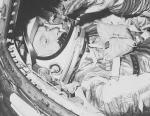 John Glenn: Friendship 7 To Discovery
29.10.1998
Rehearsing for his historic flight on February 20, 1962, Mercury program astronaut John H. Glenn Jr. works in a cramped training capsule preparing for a few hours' voyage through space. Dubbed Friendship...
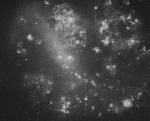 Shell Game in the LMC
18.05.2006
An alluring sight in dark southern skies, the Large Magellanic Cloud (LMC) is seen here through a narrow filter that transmits only the red light of hydrogen atoms. Ionized by energetic starlight, a hydrogen atom emits the characteristic red H-alpha light as its single electron is recaptured and transitions to lower energy states.
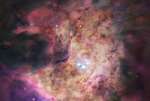 At the Heart of Orion
6.10.2012
Near the center of this sharp cosmic portrait, at the heart of the Orion Nebula, are four hot, massive stars known as the Trapezium. Gathered within a region about 1.5 light-years in radius, they dominate the core of the dense Orion Nebula Star Cluster.
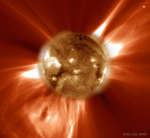 Sun Storm: A Coronal Mass Ejection
10.01.2016
What's happening to our Sun? Another Coronal Mass Ejection (CME)! The Sun-orbiting SOHO spacecraft has imaged many erupting filaments lifting off the active solar surface and blasting enormous bubbles of magnetic plasma into space.
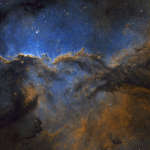 NGC 6188: The Dragons of Ara
7.11.2018
Dark shapes with bright edges winging their way through dusty NGC 6188 are tens of light-years long. The emission nebula is found near the edge of an otherwise dark large molecular cloud in the southern constellation Ara, about 4,000 light-years away.
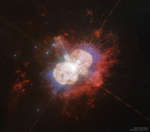 Doomed Star Eta Carinae
20.02.2019
Eta Carinae may be about to explode. But no one knows when - it may be next year, it may be one million years from now. Eta Carinae's mass - about 100 times greater than our Sun - makes it an excellent candidate for a full blown supernova.
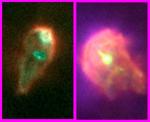 Protoplanetary Survivors in Orion
4.05.2001
The Orion Nebula is a nuturing stellar nursery filled with hot young stars and their natal clouds of gas and dust. But for planetary systems, the active star-forming region can present a hazardous and inhospitable birthplace.
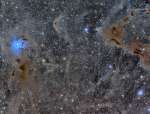 The Iris Nebula in a Field of Dust
24.06.2014
What flowers in this field of dark star dust? The Iris Nebula. The striking blue color of the Iris Nebula is created by light from the bright star SAO 19158 reflecting off of a dense patch of normally dark dust.
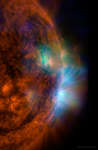 The Sun in X rays from NuSTAR
23.11.2021
Why are the regions above sunspots so hot? Sunspots themselves are a bit cooler than the surrounding solar surface because the magnetic fields that create them reduce convective heating. It is therefore unusual that regions overhead -- even much higher up in the Sun's corona -- can be hundreds of times hotter.
|
January February March April May June July August September October |
|||||||||||||||||||||||||||||||||||||||||||||||||