
|
You entered: ultraviolet
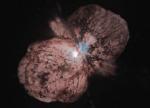 Doomed Star Eta Carinae
13.08.2000
Eta Carinae may be about to explode. But no one knows when - it may be next year, it may be one million years from now. Eta Carinae's mass - about 100 times greater than our Sun - makes it an excellent candidate for a full blown su
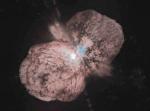 Doomed Star Eta Carinae
28.04.2002
Eta Carinae may be about to explode. But no one knows when - it may be next year, it may be one million years from now. Eta Carinae's mass - about 100 times greater than our Sun - makes it an excellent candidate for a full blown supernova.
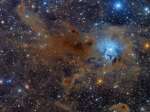 NGC 7023: The Iris Nebula
6.05.2016
These cosmic clouds have blossomed 1,300 light-years away, in the fertile starfields of the constellation Cepheus. Called the Iris Nebula, NGC 7023 is not the only nebula to evoke the imagery of flowers, though.
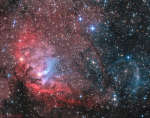 The Tulip and Cygnus X-1
1.09.2022
Framing a bright emission region, this telescopic view looks out along the plane of our Milky Way Galaxy toward the nebula rich constellation Cygnus the Swan. Popularly called the Tulip Nebula, the reddish glowing cloud of interstellar gas and dust is also found in the 1959 catalog by astronomer Stewart Sharpless as Sh2-101.
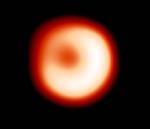 LkHa101: The Hole in the Doughnut
2.03.2001
You'd need a really big cup of coffee with this doughnut ... because the hole in the middle is about a billion kilometers across. Centered on the Sun, a circle that size would lie between the orbits of Mars and Jupiter.
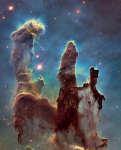 Hubble 25th Anniversary: Pillars of Creation
6.01.2015
To celebrate 25 years (1990-2015) of exploring the Universe from low Earth orbit, the Hubble Space Telescope's cameras were used to revisit its most iconic image. The result is this sharper, wider view of the region dubbed the Pillars of Creation, first imaged by Hubble in 1995.
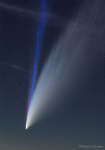 Three Tails of Comet NEOWISE
8.03.2021
What created the unusual red tail in Comet NEOWISE? Sodium. A spectacular sight back in the summer of 2020, Comet NEOWISE, at times, displayed something more than just a surprisingly striated white dust tail and a pleasingly patchy blue ion tail.
 APOD: 2025 August 13 Б Trapezium: In the Heart of Orion
13.08.2025
What lies in the heart of Orion? Trapezium: four bright stars, that can be found near the center of this sharp cosmic portrait. Gathered within a region about 1.5 light-years in radius, these stars dominate the core of the dense Orion Nebula Star Cluster.
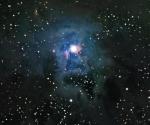 NGC 7023: The Iris Nebula
14.12.2001
Like delicate cosmic petals, these clouds of interstellar dust and gas have blossomed 1,300 light-years away in the fertile star fields of the constellation Cepheus. Sometimes called the Iris Nebula and dutifully cataloged as NGC 7023, this is not the only nebula in the sky to evoke the imagery of flowers.
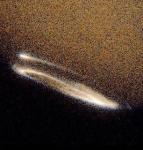 Jovian Aurora
23.01.1998
These two recently released Hubble Space Telescope close-ups show the Northern and Southern lights ... on Jupiter. Like aurora on Earth, these Jovian aurora are caused by charged particles funneled into the atmosphere above the planet's North (right) and South poles by magnetic fields.
|
January February March April May June July August September October |
|||||||||||||||||||||||||||||||||||||||||||||||||