
|
You entered: ice
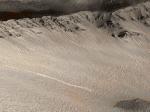 A Year of Extraterrestrial Fountains and Flows
31.12.2006
The past year was extraordinary for the discovery of extraterrestrial fountains and flows -- some offering new potential in the search for liquid water and the origin of life beyond planet Earth.. Increased evidence was uncovered that fountains spurt not only from Saturn's moon Enceladus, but from the dunes of Mars as well.
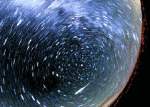 Leonid Meteor Shower Next Week
8.11.1998
Early next week, a spectacular meteor storm is expected: the 1998 Leonids. It is widely thought that that the meteors from the Leonids meteor shower are just small pieces of Comet Temple-Tuttle falling to Earth.
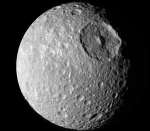 Mimas: Small Moon with a Big Crater
17.05.2009
Whatever hit Mimas nearly destroyed it. What remains is one of the largest impact craters on one of Saturn's smallest moons. The crater, named Herschel after the 1789 discoverer of Mimas, Sir William Herschel, spans about 130 kilometers and is pictured above.
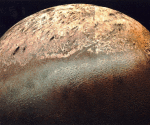 Triton: Neptune's Largest Moon
10.10.1996
Today marks the 150th anniversary of the discovery of Triton. On October 10 1846, William Lassell was observing the newly discovered planet Neptune. He was attempting to confirm his observation, made just the previous week, that Neptune had a ring. But this time he discovered that Neptune had a satellite as well.
 APOD: 2024 April 23 Б Contrail Shadow X
23.04.2024
What created this giant X in the clouds? It was the shadow of contrails illuminated from below. When airplanes fly, humid engine exhaust may form water droplets that might freeze in Earth's cold upper atmosphere. These persistent streams of water and ice scatter light from the Sun above and so appear bright from below.
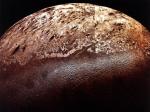 Triton: Neptunes Largest Moon
4.03.2007
In October of 1846, William Lassell was observing the newly discovered planet Neptune. He was attempting to confirm his observation, made just the previous week, that Neptune had a ring. But this time he discovered that Neptune had a satellite as well.
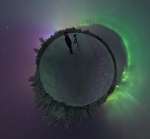 Planet Aurora Borealis
28.01.2012
Illuminated by an eerie greenish light, this remarkable little planet is covered with ice and snow and ringed by tall pine trees. Of course, this little planet is actually planet Earth, and the surrounding stars are above the horizon near Östersund, Sweden.
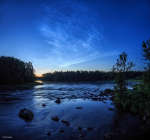 Ripples Through a Dark Sky
30.07.2016
Sunlight ripples through a dark sky on this Swedish summer midnight as noctilucent or night shining clouds seem to imitate the river below. In fact, the seasonal clouds often appear at high latitudes in corresponding summer months. Also known as polar mesospheric clouds, they form as water vapor is driven into the cold upper atmosphere.
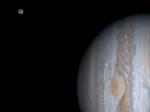 Jupiter, Europa, and Callisto
2.01.2001
As the robot Cassini spacecraft rounds Jupiter on its way toward Saturn, it has taken a sequence of images of the gas giant with its four largest moons. Previously released images have highlighted Ganymede and Io. Pictured above are the two remaining Galilean satellites: Europa and Callisto.
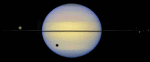 Saturn's Rings Seen Sideways
24.05.1997
Saturn's rings are actually very thin. This picture from the Hubble Space Telescope was taken on August 6, 1995 when the rings lined up sideways as seen from Earth. Saturn's largest moon Titan is seen on the left, and Titan's shadow can be seen on Saturn's cloud tops!
|
January February March April May June July August September |
|||||||||||||||||||||||||||||||||||||||||||||||||