
|
You entered: ice
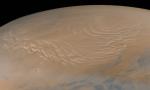 The North Pole Of Mars
24.09.1998
The North Pole of Mars is capped by layers likely consisting of ice and dust deposited over millions of years. Imaged on September 12 - early Spring for Northern Mars - by the Mars Global Surveyor's camera, this synthesized wide-angle color view shows the rippled, eroded polar terrain covered with pinkish seasonal carbon dioxide frost.
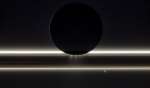 Enceladus in Silhouette
14.02.2018
One of our Solar System's most tantalizing worlds, Enceladus is backlit by the Sun in this Cassini spacecraft image from November 1, 2009. The dramatic illumination reveals the plumes that continuously spew into space from the south pole of Saturn's 500 kilometer diameter moon.
 Crescent Enceladus
15.12.2023
Peering from the shadows, the Saturn-facing hemisphere of tantalizing inner moon Enceladus poses in this Cassini spacecraft image. North is up in the dramatic scene captured during November 2016 as Cassini's camera was pointed in a nearly sunward direction about 130,000 kilometers from the moon's bright crescent.
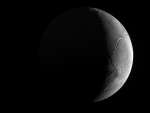 Crescent Enceladus
6.02.2026
Peering from the shadows, the Saturn-facing hemisphere of tantalizing inner moon Enceladus poses in this Cassini spacecraft image. North is up in the dramatic scene captured during November 2016 as Cassini's camera was pointed in a nearly sunward direction about 130,000 kilometers from the moon's bright crescent.
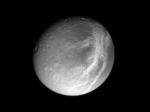 Saturns Moon Dione from Cassini
30.11.2004
What causes the bright streaks on Dione? Recent and likely future images of this unusual moon by the robot Cassini spacecraft now orbiting Saturn might help us find out. The above image was taken at the end of October from a distance of about one million kilometers.
 Stereo Helene
31.05.2024
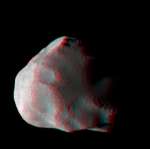
Get out your red/blue glasses and float next to Helene, small, icy moon of Saturn. Appropriately named, Helene is a Trojan moon, so called because it orbits at a Lagrange point. A Lagrange point is a gravitationally stable position near two massive bodies, in this case Saturn and larger moon Dione.
 Stereo Helene
28.03.2025
Get out your red/blue glasses and float next to Helene, small, icy moon of Saturn. Appropriately named, Helene is a Trojan moon, so called because it orbits at a Lagrange point. A Lagrange point is a gravitationally stable position near two massive bodies, in this case Saturn and larger moon Dione.
 Martian Moon Phobos from MGS
1.07.2003
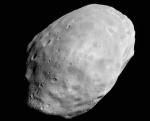
Why is Phobos so dark? Phobos, the largest and innermost of two Martian moons, is the darkest moon in the entire Solar System. Its unusual orbit and color indicate that it may be a captured asteroid composed of a mixture of ice and dark rock.
 October Mars
28.10.2005
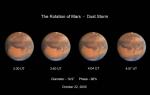
This October, Mars has become a bright, yellowish star in planet Earth's sky as it approaches oppositon, the period when Mars and Earth pass close as they orbit the Sun. How close is Mars? A mere 70 million kilometers or so, close enough to allow Earth-bound astronomers excellent views of the alluring Red Planet.
 Europa Rising
7.05.2007
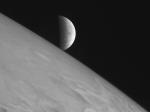
When passing Jupiter on your way to Pluto, what should you look for? NASA pondered just this question recently, and the response from one space enthusiast was to capture the above breathtaking moonrise.
|
January February March April May June July August September |
|||||||||||||||||||||||||||||||||||||||||||||||||