
|
You entered: ice
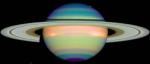 Infrared Saturn
24.04.1998
This delightfully detailed false color image of Saturn has been earmarked to celebrate the 8th anniversary of the orbiting Hubble Space Telescope. The picture is a combination of three images taken in January of this year with the Hubble's new NICMOS instrument and shows the lovely ringed planet in reflected infrared light.
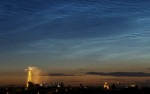 Noctilucent Clouds over Paris Fireworks
10.07.2018
It's northern noctilucent cloud season -- perhaps a time to celebrate! Composed of small ice crystals forming only during specific conditions in the upper atmosphere, noctilucent clouds may become visible at sunset during late summer when illuminated by sunlight from below.
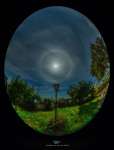 Sandy and the Moon Halo
20.06.2024
Last April's Full Moon shines through high clouds near the horizon, casting shadows in this garden-at-night skyscape. Along with canine sentinel Sandy watching the garden gate, the wide-angle snapshot also captured the bright Moon's 22 degree ice halo. But June's bright Full Moon will cast shadows too.
 APOD: 2024 October 7 Б The Long Tails of Comet Tsuchinshan ATLAS
7.10.2024
A bright comet is moving into the evening skies. C/2023 A3 (TsuchinshanБATLAS) has brightened and even though it is now easily visible to the unaided eye, it is so near to the Sun that it is still difficult to see. Pictured, Comet TsuchinshanБATLAS was captured just before sunrise from an Andes Mountain in Peru.
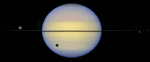 Saturn's Rings Seen Sideways
29.04.1996
Saturn's rings are actually very thin. This picture from the Hubble Space Telescope was taken on August 6, 1995 when the rings lined up sideways as seen from Earth. Saturn's largest moon Titan is seen on the left, and Titan's shadow can be seen on Saturn's cloud tops!
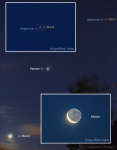 When Mars met Neptune
13.01.2017
On January 1, a Mars-assisted viewing opportunity allowed binocular-equipped skygazers to cross an ice giant off their life list. Remarkably, the line-of-sight to the bright Red Planet could guide you to within 0.02 degrees of a faint, pale Neptune in Earth's night skies.
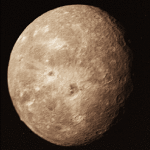 Uranus's Moon Oberon: Impact World
8.04.1996
Oberon is the most distant and second largest moon of Uranus. Discovered by William Herschel in 1787, the properties of the world remained relatively unknown until the robot spacecraft Voyager 2 passed it during its flyby of Uranus in January 1986.
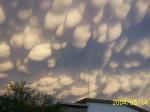 Mammatus Clouds Over Mexico
7.06.2004
When do cloud bottoms appear like bubbles? Normal cloud bottoms are flat because moist warm air that rises and cools will condense into water droplets at a very specific temperature, which usually corresponds to a very specific height. After water droplets form that air becomes an opaque cloud.
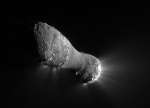 700 Kilometers Below Comet Hartley 2
8.11.2010
What kind of comet is this? Last week, NASA's robotic EPOXI spacecraft whizzed past Comet 103P/Hartley, also known as Comet Hartley 2, and recorded images and data that are both strange and fascinating. EPOXI was near its closest approach -- about 700 kilometers away -- when it snapped the above picture.
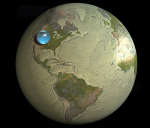 All the Water on Planet Earth
15.05.2012
How much of planet Earth is made of water? Very little, actually. Although oceans of water cover about 70 percent of Earth's surface, these oceans are shallow compared to the Earth's radius.
|
January February March April May June July August September |
|||||||||||||||||||||||||||||||||||||||||||||||||