
|
You entered: tail
 Comet Holmes in Outburst
26.10.2007
Comet 17P/Holmes stunned comet watchers across planet Earth earlier this week. On October 24, it increased in brightness over half a million times in a matter of hours. The outburst transformed it from...
 Outbound Comet ZTF
24.03.2023
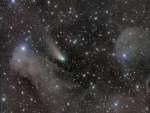
Former darling of the northern sky Comet C/2022E3 (ZTF) has faded. During its closest approach to our fair planet in early February Comet ZTF was a mere 2.3 light-minutes distant. Then known as the green comet, this visitor from the remote Oort Cloud is now nearly 13.3 light-minutes away.
 The Milky Way Near the Northern Cross
15.05.1996
This beautiful image of the sky near the bright star Deneb (just above center) reveals the stars, nebulae, and dark clouds along the plane of our Milky Way Galaxy as seen from the northern hemisphere (near Columbia Missouri, USA). Just below Deneb lies the suggestively shaped North American emission nebula.
 LightSail A
19.06.2015
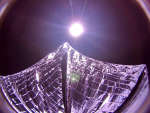
Hitching a ride to low Earth orbit, LightSail A accomplished a challenging test mission, unfurling its 32 square meter mylar solar sail on June 7. This dramatic image from one of the bread loaf sized spacecraft's fisheye cameras captures the deployed sail glinting in sunlight.
 Hale-Bopp's Hoods
14.04.1997
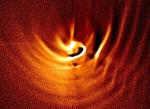
Comet Hale-Bopp is spinning. The nucleus of the comet is a dirty snowball about 25 miles in diameter that spins about once every 12 hours. As Comet Hale-Bopp spins, parts of the comet's surface shoot away in jets.
 Recycling NGC 5291
21.11.2015
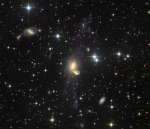
Following an ancient galaxy-galaxy collision 200 million light-years from Earth, debris from a gas-rich galaxy, NGC 5291, was flung far into intergalactic space. NGC 5291 and the likely interloper, also known as the "Seashell" galaxy, are captured near the center of this spectacular scene.
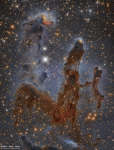 Pillars of the Eagle Nebula in Infrared
20.06.2018
Newborn stars are forming in the Eagle Nebula. Gravitationally contracting in pillars of dense gas and dust, the intense radiation of these newly-formed bright stars is causing surrounding material to boil away. This image...
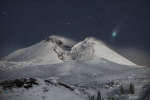 Comet ZTF over Mount Etna
28.01.2023
Comet-like plumes are blowing over the volcanic peaks of Mount Etna in this wintry mountain-and-skyscape from planet Earth. The stacked and blended combination of individual exposures recorded during the cold night of January 23, also capture naked-eye Comet ZTF just above Etna's snowy slopes.
 APOD: 2023 August 21 Б Introducing Comet Nishimura
21.08.2023
Will Comet Nishimura become visible to the unaided eye? Given the unpredictability of comets, no one can say for sure, but it currently seems like a good bet. The comet was discovered only ten days ago by Hideo Nishimura during 30-second exposures with a standard digital camera.
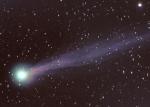 Comet SWAN Outburst
28.10.2006
Near its closest approach to planet Earth, comet SWAN (C/2006 M4) brightened unexpectedly earlier this week, becoming visible to naked-eye observers under dark night skies. Telescopic observers also noticed dramatic changes in the comet's colorful coma and tail, seen in this view recorded on October 25th.
|
January February March April May June July August September October |
|||||||||||||||||||||||||||||||||||||||||||||||||