
|
You entered: tail
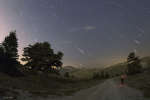 Perseid Meteors over Turkey
1.08.2017
The Perseid Meteor Shower, usually the best meteor shower of the year, will peak late next week. A person watching a clear sky from a dark location might see a bright meteor every minute.
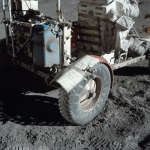 Lunar Dust and Duct Tape
28.03.2025
Why is the Moon so dusty? On Earth, rocks are weathered by wind and water, creating soil and sand. On the Moon, eons of constant micrometeorite bombardment have blasted away at the rocky surface creating a layer of powdery lunar soil or regolith.
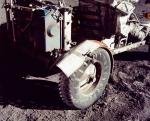 Lunar Dust and Duct Tape
10.11.2001
Why is the Moon dusty? On Earth, rocks are weathered by wind and water, creating soil and sand. On the Moon, the long history of micrometeorite bombardment has blasted away at the rocky surface creating a layer of powdery lunar soil or regolith. This lunar regolith could be a scientific and industrial bonanza.
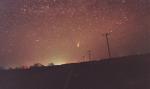 Comet Hale-Bopp is That Bright
27.02.1997
What's that fuzzy star? It's not a star, it's Comet Hale-Bopp. Not only has Comet Hale-Bopp become easy to see in the morning sky, it has become hard not to see it. It's that bright. Any morning just before sunrise, look towards the east.
 Two Comets in Southern Skies
27.05.2004
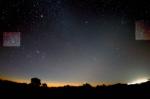
Wielding a very wide-angle lens, astronomer Gordon Garradd was able to capture two naked-eye comets in one picture looking toward the west from Loomberah, New South Wales, Australia. At the far left lies comet C/2002 T7 (LINEAR) and at the far right, comet C/2001 Q4 (NEAT).
 Lightning Storm Moves Across the USA
15.05.2017
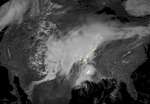
Watch a huge lightning storm move across the eastern USA. The huge storm caused much damage and unfortunately some loss of life for people in its path. Seen from space, the lightning is seen as momentary flashes in the featured time-lapse video recorded last month by the Geostationary Lightning Mapper (GLM) aboard the GOES-16 satellite.
 The M7 Open Star Cluster in Scorpius
6.04.2005
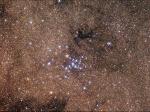
M7 is one of the most prominent open clusters of stars on the sky. The cluster, dominated by bright blue stars, can be seen with the naked eye in a dark sky in the tail of the constellation of Scorpius.
 Comet Lulin and Distant Galaxies
7.03.2009
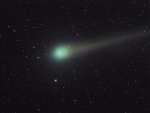
Now fading in our night sky, Comet Lulin has provided some lovely cosmic vistas. Moving rapidly against the background of stars, Lulin briefly posed with the likes of Saturn, and Regulus (Alpha Leo). But here it is seen against a field of distant galaxies.
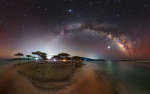 Light and Glory over Crete
16.11.2020
The month was July, the place was the Greek island of Crete, and the sky was spectacular. Of course there were the usual stars like Polaris, Vega, and Antares -- and that common asterism everyone knows: the Big Dipper. But this sky was just getting started.
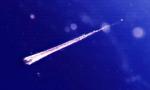 Catching Falling Stardust
1.02.1997
This carrot shaped track is actually little more than 5 hundredths of an inch long. It is the trail of a meteroid through aerogel exposed to space by the shuttle launched EURECA (European Recoverable Carrier) spacecraft.
|
January February March April May June July August September October |
|||||||||||||||||||||||||||||||||||||||||||||||||