
|
You entered: tail
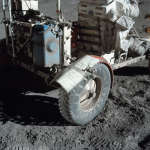 Lunar Dust and Duct Tape
13.12.2022
Why is the Moon so dusty? On Earth, rocks are weathered by wind and water, creating soil and sand. On the Moon, the history of constant micrometeorite bombardment has blasted away at the rocky surface creating a layer of powdery lunar soil or regolith.
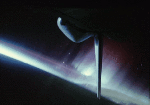 Aurora Astern
25.10.1995
Sailing upside down, 115 nautical miles above Earth, the crew of the Space Shuttle Endeavour made this spectacular time exposure of the southern aurora (aurora australis) in October of 1994. The aurora, also known...
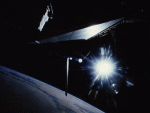 The Equal Night
22.09.1996
Today the Sun crosses the celestial equator heading south -- marking the Autumnal Equinox, the first day of Autumn. Equinox means equal night and with the Sun on the celestial equator, Earthlings will experience 12 hours of daylight and 12 hours of darkness.
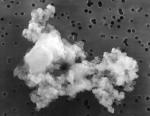 A Piece of Interplanetary Dust
13.08.2001
The dust that pervades our Solar System is not the dust that pervades our homes. Solar System dust comes from comets and asteroids, whereas house dust is most likely lint or dead cells. Pictured above is a piece of interplanetary dust caught by a high-flying U2-type aircraft.
 A Wind From The Sun
16.02.1997
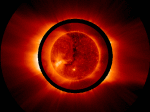
A wind from the Sun blows through our Solar System. The behaviour of comet tails as they flapped and waved in this interplanetary breeze gave astronomers the first hint of its existence. Streaming outward...
 Comet Lovejoy before a Globular Star Cluster
30.12.2014
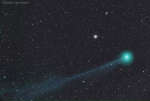
Comet Lovejoy has become visible to the unaided eye. To see the comet, just go outside an hour or so after sunset and look for a fuzzy patch to the right of Orion's belt. Binoculars and a star chart may help.
 Five Bright Comets from SOHO
9.10.2024
Five bright comets are compared in these panels, recorded by a coronograph on board the long-lived, sun-staring SOHO spacecraft. Arranged chronologically all are recognizable by their tails streaming away from...
 Goat Aurora Over Greenland
3.10.2012
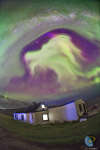
Sometimes it's hard to believe what you see in the sky. During the Shelios Expedition to Greenland in late August, even veteran sky enthusiasts saw auroras so colorful, so fast changing, and so unusual in form that they could remember nothing like it.
 The M7 Open Star Cluster in Scorpius
5.05.2002
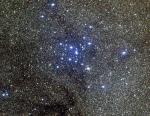
M7 is one of the most prominent open clusters of stars on the sky. The cluster, dominated by bright blue stars, can be seen with the naked eye in a dark sky in the tail of the constellation of Scorpius.
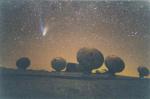 Hale-Bopp and the Plateau de Bure Interferometer
15.04.1997
Comet Hale-Bopp is being observed by many different telescopes. Here the comet is pictured behind the array of radio telescopes which compose the Plateau de Bure Interferometer. These telescopes are being used to detect the presence of different molecules in the coma and tail of Comet Hale-Bopp.
|
January February March April May June July August September October |
|||||||||||||||||||||||||||||||||||||||||||||||||