
|
You entered: tail
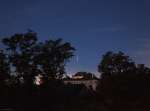 Perseid over Albrechtsberg Castle
25.08.2012
Medieval Albrechtsberg castle is nestled in trees near the northern bank of the river Pielach and the town of Melk, Austria. In clearing night skies on August 12 it stood under constellations of the northern summer, including Aquarius, Aquila, and faint, compact Delphinus (above and right of center) in this west-looking skyview.
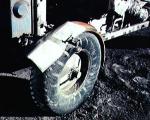 Lunar Dust and Duct Tape
27.03.1998
Why is the Moon dusty? On Earth, rocks are weathered by wind and water, creating soil and sand. On the Moon, the long history of micrometeorite bombardment has blasted away at the rocky surface creating a layer of powdery lunar soil or regolith. This lunar regolith could be a scientific and industrial bonanza.
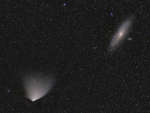 Comet PANSTARRS and the Andromeda Galaxy
3.04.2013
Currently, comet PANSTARRS is passing nearly in front of the galaxy Andromeda. Coincidentally, both comet and galaxy appear now to be just about the same angular size. In physical size, even though Comet PANSTARRS...
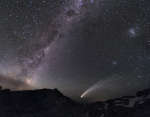 Three Galaxies and a Comet
20.10.2013
Diffuse starlight and dark nebulae along the southern Milky Way arc over the horizon and sprawl diagonally through this gorgeous nightscape. The breath-taking mosaic spans a wide 100 degrees, with the rugged terrain of the Patagonia, Argentina region in the foreground.
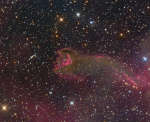 CG4: A Ruptured Cometary Globule
13.05.2014
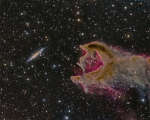
Can a gas cloud grab a galaxy? It's not even close. The "claw" of this odd looking "creature" in the above photo is a gas cloud known as a cometary globule. This globule, however, has ruptured. Cometary globules are typically characterized by dusty heads and elongated tails.
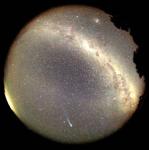 A Southern Sky View
26.02.1998
From horizon to horizon, the night sky above Loomberah, New South Wales, Australia was photographed by astronomer Gordon Garradd on March 22, 1996. Garradd used a home made all-sky camera with a fish-eye lens, resulting in a circular 200 degree field of view.
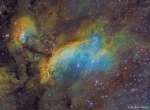 IC 4628: The Prawn Nebula
4.07.2016
South of Antares, in the tail of the nebula-rich constellation Scorpius, lies emission nebula IC 4628. Nearby hot, massive stars, millions of years young, radiate the nebula with invisible ultraviolet light, stripping electrons from atoms. The electrons eventually recombine with the atoms to produce the visible nebular glow, dominated by the red emission of hydrogen.
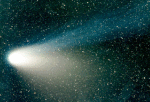 Comet Hale-Bopp Enters the Evening Sky
7.03.1997
You no longer have to wake-up early to see Comet Hale-Bopp. From many northern locations, you can now go outside just after sunset and see Comet Hale-Bopp above the north-western horizon. Both writer/editors of APOD are impressed by how bright Comet Hale-Bopp has become, and how easily visible it is.
 CG4: A Ruptured Cometary Globule
6.08.2007
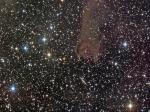
Can a gas cloud eat a galaxy? It's not even close. The odd looking "creature" or "hand" extending down from the top of the above photo is a gas cloud known as a cometary globule. This globule, however, has ruptured. Cometary globules are typically characterized by dusty heads and elongated tails.
 APOD: 2023 January 4 Б CG4: The Globule and the Galaxy
4.01.2023
Can a gas cloud eat a galaxy? It's not even close. The "claw" of this odd looking "creature" in the featured photo is a gas cloud known as a cometary globule. This globule, however, has ruptured. Cometary globules are typically characterized by dusty heads and elongated tails.
|
January February March April May June July August September October |
|||||||||||||||||||||||||||||||||||||||||||||||||