
|
You entered: tail
 The Colors of Comet Hyakutake
29.03.1996
The colors of Comet Hyakutake are caused by the action of sunlight on the dust and gas produced by the warming nucleus. The microscopic dust particles reflect sunlight while the sun's ultraviolet radiation excites and ionizes the gas molecules causing them to glow or fluoresce in a range of visible colors.
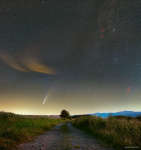 Comet NEOWISE and Nebulae
20.07.2020
Would you brave wild animals to photograph this sky? One astrophotographer did -- and we all get to reap the rewards. First, thousands of stars were visible with many of the brightest impressively blue. Next, several red-glowing nebulae were discernible, including the California Nebula on the far right, and, above it, the Heart and Soul nebulae.
 A Sudden Jet on Comet 67P?
18.11.2015
There she blows! A dramatic demonstration of how short-lived some comet jets can be was documented in late July by the robotic Rosetta spacecraft orbiting the nucleus of Comet 67P/Churyumov-Gerasimenko. The featured animation depicts changes in the rotating comet with three illuminating stills.
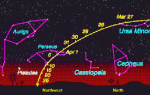 Comet Hyakutake Finder Chart for Early April
31.03.1996
During April Comet Hyakutake heads in toward the Sun after passing the Earth. At this time the comet's orbit places it north of the Earth. Remaining visible in the northern sky as it nears the Sun, it will set progressively earlier in the evening.
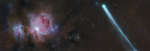 APOD: 2026 May 12 Б The Conjunction of Comet R3 PanSTARRS and the Orion Nebula
12.05.2026
TodayБs composite image features something old, something new, something borrowed, and something blue! Comet R3 PanSTARRS, streaking across the right of the image, likely originated from the Oort Cloud, meaning it is an old Solar System relic from billions of years ago.
 Comet Hyakutake Passes the Earth
16.12.2009
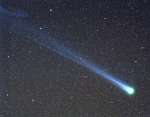
In 1996, an unexpectedly bright comet passed by planet Earth. Discovered less than two months before, Comet C/1996 B2 Hyakutake came within only 1/10th of the Earth-Sun distance from the Earth in late March.
 Near the Nucleus of Hyakutake
28.03.1996
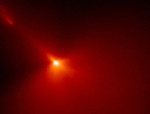
NASA's Hubble Space Telescope captured this image of the near-nuclear region of Comet Hyakutake on March 25 as the comet approached within 9.3 million miles of the Earth. It covers a relatively "small" 2,000 mile wide area with the sunward direction toward the lower right (tailward is upper left).
 A Meteoric View of Apollo 13
9.07.1995
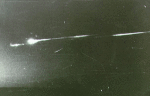
Meteors, also called shooting stars, normally begin as bits of dust from the tails of comets or even small pieces chipped off asteroids. Falling toward Earth, these particles enter the atmosphere at extremely high speeds. Friction with the air heats them up and makes them glow brightly.
 Lightning Below
2.12.1995
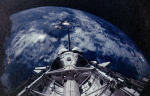
In May of 1993, the Space Shuttle Columbia orbited the Earth carrying the Spacelab Deutsche 2 (SL-D
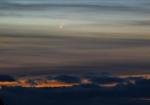 McNaught Now Brightest Comet in Decades
9.01.2007
The brightest comet in decades is unexpectedly now visible. The most optimistic predictions have Comet McNaught (C/2006 P1) shortly becoming one of the brightest comets of the past century. For the next few days...
|
January February March April May June July August September October |
|||||||||||||||||||||||||||||||||||||||||||||||||