
|
You entered: tail
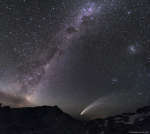 Three Galaxies and a Comet
14.01.2018
Diffuse starlight and dark nebulae along the southern Milky Way arc over the horizon and sprawl diagonally through this gorgeous nightscape. The breath-taking mosaic spans a wide 100 degrees, with the rugged terrain of the Patagonia, Argentina region in the foreground.
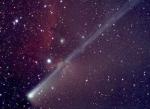 Comet SOHO and Nebulae in Orion
4.06.1998
Astrophotographer Michael Horn captured this gorgeous view of comet SOHO in the dark night sky above Wandibindle, Queensland, Australia on May 23rd. On this date, comet SOHO was moving against the background of the nebula-rich constellation of Orion.
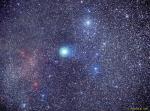 Skyscape with Comet Holmes
9.11.2007
This gorgeous skyscape spans some 10 degrees across the heroic constellation Perseus, about the size of a generous binocular field of view. The deep exposure includes bright stars, emission nebulae, star clusters, and, of course, the famous Comet Holmes. To identify the celestial landmarks, just place your cursor over the image.
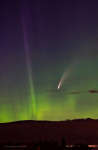 NEOWISE of the North
17.07.2020
After local midnight on July 14 comet NEOWISE was still above the horizon for Goldenrod, Alberta, Canada, just north of Calgary, planet Earth. In this snapshot it makes for an awesome night with dancing displays of the northern lights. The long-tailed comet and auroral displays are beautiful apparitions in the north these days.
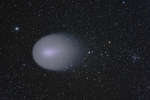 Comet Holmes Over Hungary
5.12.2007
Comet Holmes refuses to fade. The unusual comet that surprisingly brightened nearly a million-fold in late October continues to remain visible to the unaided eye from dark locations. Night to night, Comet 17P/Holmes is slowly gliding through the constellation Perseus, remaining visible to northern observers during much of the night right from sunset.
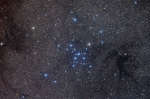 M7: Open Star Cluster in Scorpius
12.09.2012
M7 is one of the most prominent open clusters of stars on the sky. The cluster, dominated by bright blue stars, can be seen with the naked eye in a dark sky in the tail of the constellation of the Scorpion (Scorpius).
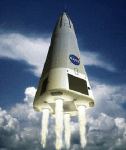 The Delta Clipper
28.10.1995
The Delta Clipper experimental rocket or DC-X is intended as a development vehicle to pave the way for a reusable single stage to orbit rocket. Shown here, in an artists conception, it has made...
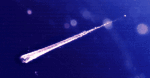 Catching Falling Stardust
25.01.1996
This carrot shaped track is actually little more than 5 hundredths of an inch long. It is the trail of a meteroid through a gel exposed to space in low earth orbit by the shuttle launched EURECA (European Recoverable Carrier) spacecraft.
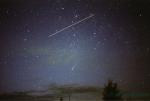 Comet Ikeya Zhang Meets The ISS
26.04.2002
Still catching the Sun's rays, the International Space Station (ISS) cruises across the early evening sky above Tomahawk, Wisconsin, USA. Recorded on April 9 around 9 pm CDT in a 30 second exposure, the sunlit space station traced this bright streak moving east (right) through the constellation Cassiopeia.
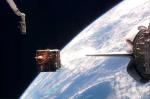 Deploying Spartan
12.08.1999
Last October the Space Shuttle Discovery deployed Spartan 201, a spacecraft that monitored the corona of the Sun. Instruments on Spartan 201 were used to estimate the density of electrons emitted into the solar...
|
January February March April May June July August September October |
|||||||||||||||||||||||||||||||||||||||||||||||||