
|
You entered: tail
 The Comet and the Galaxy
25.11.1997
The Moon almost ruined this photograph. During late March and early April, Comet Hale-Bopp passed nearly in front of the Andromeda Galaxy. Here the Great Comet of 1997 and the Great Galaxy in Andromeda were photographed together on March 24th. The problem was the brightness of the Moon.
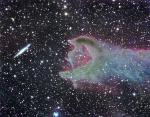 CG4: A Ruptured Cometary Globule
13.10.2002
The odd looking "creature" to the right of center in the above photo is a gas cloud known as a cometary globule. This globule, however, has ruptured. Cometary globules are typically characterized by dusty heads and elongated tails.
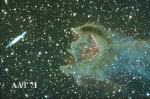 CG4: A Ruptured Cometary Globule
6.12.1998
The odd looking "creature" to the right of center in the above photo is a gas cloud known as a cometary globule. This globule, however, has ruptured. Cometary globules are typically characterized by dusty heads and elongated tails.
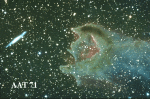 CG4: A Ruptured Cometary Globule
28.12.1996
The odd looking "creature" to the right of center in the above photo is a gas cloud known as a cometary globule. This globule, however, has ruptured. Cometary globules are typically characterized by dusty heads and elongated tails.
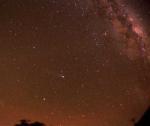 Comet Hyakutake and the Milky Way
17.08.1998
Two years ago, the Great Comet of 1996, Comet Hyakutake, inched across our northern sky during its long orbit around the Sun. Visible above as the bright spot with the faint tail near...
 APOD: 2023 August 27 Б Three Galaxies and a Comet
27.08.2023
Diffuse starlight and dark nebulae along the southern Milky Way arc over the horizon and sprawl diagonally through this gorgeous nightscape. The breath-taking mosaic spans a wide 100 degrees, with the rugged terrain of the Patagonia, Argentina region in the foreground.
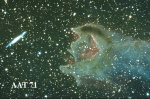 CG4: A Ruptured Cometary Globule
5.10.1995
The odd looking "creature" to the right of center in the above photo is a gas cloud known as a cometary globule. This globule, however, has ruptured. Cometary globules are typically characterized by dusty heads and elongated tails.
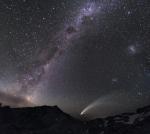 Three Galaxies and a Comet
30.03.2007
Diffuse starlight and dark nebulae along the southern Milky Way arc over the horizon and sprawl diagonally through this gorgeous nightscape. The breath-taking mosaic spans a wide 100 degrees, with the rugged terrain of the Patagonia, Argentina region in the foreground.
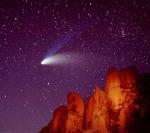 Hale-Bopp from Indian Cove
6.08.1997
Good cameras were able to obtain impressive photographs of Comet Hale-Bopp when at its brightest earlier this year. In the above photograph taken April 5th, Comet Hale-Bopp was imaged from the Indian Cove Campground in the Joshua Tree National Forest in California, USA.
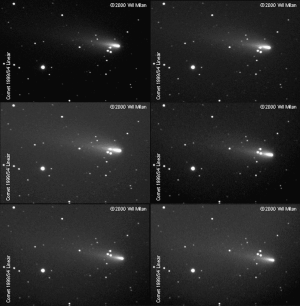 Comet LINEAR Approaches
4.07.2000
Just possibly, a new comet may become bright enough to see without binoculars later this month. Comet C/1999 S4 LINEAR is rapidly approaching both the Earth and the Sun from the outer Solar System, and should be at its brightest around 2000 July 25 in the early evening sky of northern observers.
|
January February March April May June July August September October |
|||||||||||||||||||||||||||||||||||||||||||||||||