
|
You entered: tail
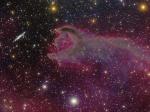 CG4: A Ruptured Cometary Globule
14.03.2006
Can a gas cloud eat a galaxy? It's not even close. The odd looking "creature" in the center of the above photo is a gas cloud known as a cometary globule. This globule, however, has ruptured. Cometary globules are typically characterized by dusty heads and elongated tails.
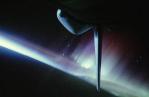 Aurora Astern
10.02.2001
Sailing upside down, 115 nautical miles above Earth, the crew of the Space Shuttle Endeavour made this spectacular time exposure of the southern aurora (aurora australis) in October of 1994. Aurora, also known as the northern and southern lights, appear as luminous bands or streamers of light which can extend to altitudes of 200 miles.
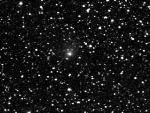 Announcing Comet Hale-Bopp
20.08.1995
The pictured fuzzy patch may become one of the most spectacular comets this century. Although it is very hard to predict how bright a comet will become, Comet Hale-Bopp, named for its discoverers...
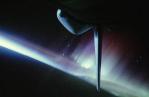 Aurora Astern
30.11.1996
Sailing upside down, 115 nautical miles above Earth, the crew of the Space Shuttle Endeavour made this spectacular time exposure of the southern aurora (aurora australis) in October of 1994. The aurora, also known...
 M7: Open Star Cluster in Scorpius
13.07.2016
M7 is one of the most prominent open clusters of stars on the sky. The cluster, dominated by bright blue stars, can be seen with the naked eye in a dark sky in the tail of the constellation of the Scorpion (Scorpius).
 IC 4628: The Prawn Nebula
7.09.2012
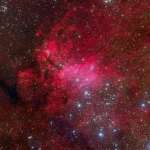
South of Antares, in the tail of the nebula-rich constellation Scorpius, lies emission nebula IC 4628. Nearby hot, massive stars, millions of years young, radiate the nebula with invisible ultraviolet light, stripping electrons from atoms. The electrons eventually recombine with the atoms to produce the visible nebular glow, dominated by the red emission of hydrogen.
 A Fisheye View of Comet Hale-Bopp
25.08.1997
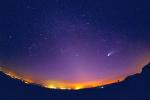
Thousands of stars, several constellations, a planet and a comet all graced the western horizon over Ujue, Spain just after sunset on April 4th, 1997. Because the picture was taken with a fisheye lens, much of the whole night sky is visible. Comet Hale-Bopp, with both tails blazing, appears right of center.
 Lunar Dust and Duct Tape
29.05.2021
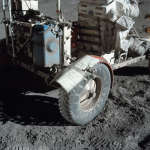
Why is the Moon so dusty? On Earth, rocks are weathered by wind and water, creating soil and sand. On the Moon, the history of constant micrometeorite bombardment has blasted away at the rocky surface creating a layer of powdery lunar soil or regolith.
 Comet Pons-Brooks at Night
4.04.2024
In dark evening skies over June Lake, northern hemisphere, planet Earth, Comet 12P/Pons-Brooks stood just above the western horizon on March 30. Its twisted turbulent ion tail and diffuse greenish coma are captured in this two degree wide telescopic field of view along with bright yellowish star Hamal also known as Alpha Arietis.
 Lunar Dust and Duct Tape
1.05.1999
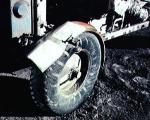
Why is the Moon dusty? On Earth, rocks are weathered by wind and water, creating soil and sand. On the Moon, the long history of micrometeorite bombardment has blasted away at the rocky surface creating a layer of powdery lunar soil or regolith. This lunar regolith could be a scientific and industrial bonanza.
|
January February March April May June July August September October |
|||||||||||||||||||||||||||||||||||||||||||||||||