
|
You entered: tail
 A Southern Sky View
10.03.2002
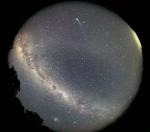
On 1996 March 22, a Galaxy and a comet shared the southern sky. They were captured together, from horizon to horizon, in the night sky above Loomberah, New South Wales, Australia by astronomer Gordon Garradd. Garradd used a home made all-sky camera with a fisheye lens, resulting in a circular 200 degree field of view.
 Comet Jacques, Heart and Soul
22.08.2014
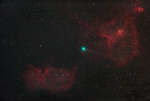
On July 13th, a good place to watch Comet Jacques was from Venus. Then, the recently discovered visitor (C/2014 E2) to the inner solar system passed within about 14.5 million kilometers of our sister planet.
 Comet Leonard and the Whale Galaxy
3.12.2021
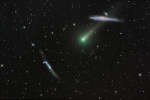
Sweeping through northern predawn skies, on November 24 Comet Leonard (C/2021 A1) was caught between two galaxies in this composite telescopic image. Sporting a greenish coma the comet's dusty tail seems to harpoon the heart of NGC 4631 (top) also known as the Whale Galaxy.
 Comet NEAT in Southern Skies
6.03.2003
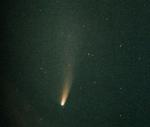
After last month's dramatic swoop past the Sun, Comet NEAT (C/2002 V1) appeared as a naked-eye comet, emerging from the evening twilight in planet Earth's southern skies. On March 1st, New Zealand...
 The Equal Night
20.03.2005
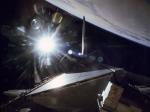
Today, the Sun crosses the celestial equator heading north, marking the Vernal Equinox -- the first day of spring in the Northern Hemisphere and autumn in the south. Equinox means equal night and with the Sun on the celestial equator, Earthlings will experience 12 hours of daylight and 12 hours of darkness.
 Comet McNaught Over New Zealand
19.10.2014
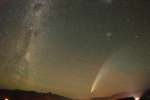
Comet McNaught was perhaps the most photogenic comet of modern times -- from Earth. After making quite a show in the northern hemisphere in early January of 2007, the comet moved south and developed a long and unusual dust tail that dazzled southern hemisphere observers.
 Massive Stars in NGC 6357
9.10.2008
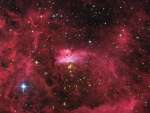
Massive Stars lie within NGC 6357, an expansive emission nebula complex some 8,000 light-years away in the tail of the constellation Scorpius. In fact, positioned just below center in this close-up view...
 Announcing Comet Catalina
18.08.2015
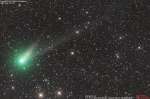
Will Comet Catalina become visible to the unaided eye? Given the unpredictability of comets, no one can say for sure, but it seems like a good bet. The comet was discovered in 2013 by observations of the Catalina Sky Survey.
 Comet NEAT Approaches the Sun
10.02.2003
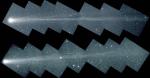
A comet may likely become visible to the unaided eye over the next few days above the horizon where the Sun has just set. Comet NEAT (C/ 2002 V1), discovered last November, has brightened dramatically as it approached the Sun.
 Comet Meets Ring Nebula: Part II
12.05.2006
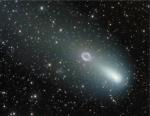
Moving rapidly through planet Earth's night sky, Fragment C of crumbling comet 73P/Schwassmann-Wachmann 3 passed almost directly in front of M57 - the Ring Nebula, and faint spiral galaxy IC 1296 on May 8.
|
January February March April May June July August September October |
|||||||||||||||||||||||||||||||||||||||||||||||||