
|
You entered: crescent
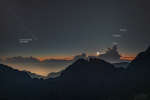 APOD: 2026 April 18 Б PanSTARRS and Planets
17.04.2026
Near the eastern horizon before sunrise, Comet C/2025 R3 PanSTARRS is getting brighter. Readily visible in binoculars and small telescopes, the comet may be just on the verge of naked-eye visibility from dark sky sites.
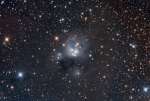 Young Suns of NGC 7129
3.10.2008
Young suns still lie within dusty NGC 7129, some 3,000 light-years away toward the royal constellation Cepheus. While these stars are at a relatively tender age, only about a million years old, it is likely that our own Sun formed in a similar stellar nursery some five billion years ago.
 Moon and Planets Over Catalonia
29.02.2012
Venus and Jupiter will appear unusually close in the sky over the next month. The planetary conjunction will be easily visible to the unaided eye because Venus will appear brighter than any background star, and Jupiter will be nearly as bright. To see the near-alignment, simply look to the west after sunset.
 APOD: 2025 June 2 Б Veil Nebula: Wisps of an Ancient Supernova
1.06.2025
Wisps like this are all that remain visible of a Milky Way star. About 7,000 years ago that star exploded in a supernova, leaving the Veil Nebula. At the time, the expanding cloud was likely as bright as a crescent Moon, remaining visible for weeks to people living at the dawn of recorded history.
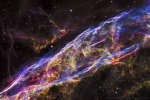 Veil Nebula: Wisps of an Exploded Star
18.09.2017
Wisps like this are all that remain visible of a Milky Way star. About 7,000 years ago that star exploded in a supernova leaving the Veil Nebula. At the time, the expanding cloud was likely as bright as a crescent Moon, remaining visible for weeks to people living at the dawn of recorded history.
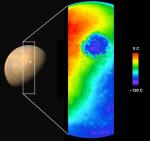 THEMIS of Mars
1.11.2001
Not an ancient Greek goddess, THEMIS is modern acronese for THermal EMission Imaging System. Above is this remarkable instrument's premier infrared image of Mars, from the newly orbiting Mars Odyssey spacecraft. Taken...
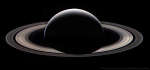 APOD: 2026 June 1 Б Saturn at Night
31.05.2026
Telescopic views of Saturn and its beautiful rings often make it the star of star parties. But this stunning view of the outer gas gaint planet's rings and night side just isn't possible from telescopes in the vicinity of planet Earth.
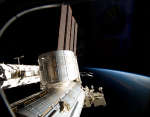 A Large Space Station Over Earth
14.04.2010
The International Space Station is the largest object ever constructed by humans in space. The station perimeter now extends over roughly the area of a football field, although only a small fraction of this is composed of modules habitable by humans.
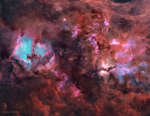 Cygnus Without Stars
29.11.2020
The sky is filled with faintly glowing gas, though it can take a sensitive camera and telescope to see it. For example, this twelve-degree-wide view of the northern part of the constellation Cygnus reveals a complex array of cosmic clouds of gas along the plane of our Milky Way galaxy.
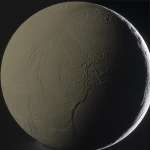 Enceladus Backlit by Saturn
8.02.2012
This moon is shining by the light of its planet. Specifically, a large portion of Enceladus pictured above is illuminated primarily by sunlight first reflected from the planet Saturn. The result is that the normally snow-white moon appears in the gold color of Saturn's cloud tops.
|
January February March April May June July August |
||||||||||||||||||||||||||||||||||||||||||||||||||||||||