
|
You entered: crescent
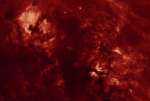 Cygnus Without Stars
24.04.2008
The sky is full of hydrogen, though it can take a sensitive camera and telescope to see it. For example, this twelve-degree-wide view of the northern part of the constellation Cygnus reveals cosmic clouds of hydrogen gas along the plane of our Milky Way galaxy.
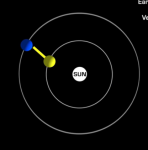 The Dance of Venus and Earth
3.06.2020
Every time Venus passes the Earth, it shows the same face. This remarkable fact has been known for only about 50 years, ever since radio telescopes have been able to peer beneath Venus' thick clouds and track its slowly rotating surface. This inferior conjunction -- when Venus and Earth are the closest -- occurs today.
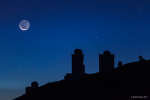 Mercury and the Da Vinci Glow
10.07.2021
On July 8th early morning risers saw Mercury near an old Moon low on the eastern horizon. On that date bright planet, faint glow of lunar night side, and sunlit crescent were captured in this predawn skyscape from Tenerife's Teide National Park in the Canary Islands.
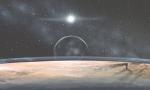 Pluto: New Horizons
18.10.2001
Pluto's horizon spans the foreground in this artist's vision, gazing sunward across that distant and still unexplored world. Titled New Horizons, the painting also depicts Pluto's companion, Charon, as a darkened, ghostly apparition with a luminous crescent against a starry background.
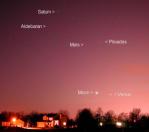 Planets in the West
18.04.2002
Have you seen any bright planets lately? Chances are if you've been outside under clear skies just after sunset, then you have. Now shining in the west as bright "stars" in the night sky, are all five planets of the solar system known to ancient astronomers - Mercury, Venus, Mars, Saturn, and Jupiter.
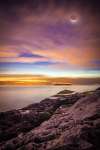 Moon, Venus, and Planet Earth
19.09.2013
In this engaging scene from planet Earth, the Moon shines through cloudy skies following sunset on the evening of September 8. Despite the fading light, the camera's long exposure still recorded a colorful, detailed view of a shoreline and western horizon looking toward the island San Gabriel from Colonia del Sacramento, Uruguay.
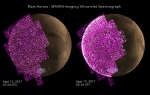 Global Aurora at Mars
6.10.2017
A strong solar event last month triggered intense global aurora at Mars. Before (left) and during (right) the solar storm, these projections show the sudden increase in ultraviolet emission from martian aurora, more than 25 times brighter than auroral emission previously detected by the orbiting MAVEN spacecraft.
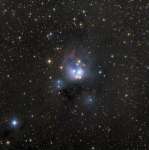 Young Suns of NGC 7129
4.09.2010
Young suns still lie within dusty NGC 7129, some 3,000 light-years away toward the royal constellation Cepheus. While these stars are at a relatively tender age, only a few million years old, it is likely that our own Sun formed in a similar stellar nursery some five billion years ago.
 APOD: 2026 April 11 Б Artemis II: Flight Day 6
11.04.2026
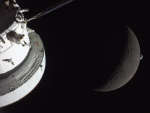
On flight day 6 (April 6) the Artemis II mission achieved a historic lunar flyby. Rounding the lunar far side, the deep space maneuver marked humanity's first venture to the Moon since Apollo 17 in 1972.
 Flying Past Neptunes Moon Triton
26.08.2014
What would it look like to fly past Triton, the largest moon of planet Neptune? Only one spacecraft has ever done this -- and now, for the first time, images of this dramatic encounter have been gathered into a movie. On 1989 August 25, the Voyager 2 spacecraft shot through the Neptune system with cameras blazing.
|
January February March April May June July August |
||||||||||||||||||||||||||||||||||||||||||||||||||||||||