
|
You entered: crescent
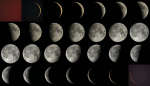 Lunation Matrix
1.10.2022
Observe the Moon every night and you'll see its visible sunlit portion gradually change. In phases progressing from New Moon to Full Moon to New Moon again, a lunar cycle or lunation is completed in about 29.5 days.
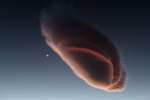 Lenticular Cloud, Moon, Mars, Venus
1.03.2015
It is not every day that such an interesting cloud photobombs your image. The original plan was to photograph a rare angular conjunction of Mars and Venus that occurred a week and a half ago, with the added bonus of a crescent Moon and the International Space Station (ISS) both passing nearby.
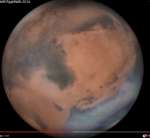 Mars at Closest Approach 2016
9.08.2016
When does Mars appear the largest? This occurs when Earth sweeps past Mars in their respective orbits around the Sun, creating a momentary Sun-Earth-Mars alignment called opposition. The featured video shows the Mars opposition that occurred earlier this year. All of the images were taken from Earth with a small telescope.
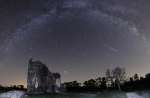 Perseid Prelude
12.08.2010
Each August, as planet Earth swings through dust trailing along the orbit of periodic comet Swift-Tuttle, skygazers can enjoy the Perseids Meteor Shower. The shower should build to its peak now, best seen from later tonight after moonset, until dawn tomorrow morning when Earth moves through the denser part of the wide dust trail.
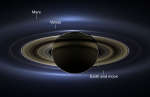 In the Shadow of Saturn
13.11.2013
In the shadow of Saturn, unexpected wonders appear. The robotic Cassini spacecraft now orbiting Saturn drifted in giant planet's shadow earlier this year and looked back toward the eclipsed Sun. Cassini saw a unique and celebrated view.
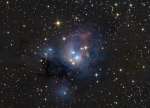 Young Suns of NGC 7129
27.10.2011
Young suns still lie within dusty NGC 7129, some 3,000 light-years away toward the royal constellation Cepheus. While these stars are at a relatively tender age, only a few million years old, it is likely that our own Sun formed in a similar stellar nursery some five billion years ago.
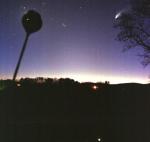 A Hale-Bopp Triple Crown
23.07.1997
It was truly a busy sky. In one of the more spectacular photos yet submitted to Astronomy Picture of the Day, Don Cooke of Lyme, New Hampshire caught the Sun, Moon, Earth, night sky, Pleiades star cluster, and Comet Hale-Bopp all in one frame.
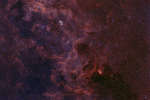 Cosmic Clouds in Cygnus
9.06.2022
These cosmic clouds of gas and dust drift through rich star fields along the plane of our Milky Way Galaxy toward the high flying constellation Cygnus. They're too faint to be seen with the unaided eye though, even on a clear, dark night.
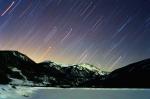 Orion Rising
25.12.2002
Orion always comes up sideways ... and was caught in the act earlier this month by astronomer Jimmy Westlake, stargazing eastward over the Rocky Mountains north of Leadville, Colorado, USA. To make this gorgeous image, Westlake placed his camera on a tripod for two exposures.
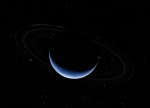 Voyager s Neptune
15.05.2014
Cruising through the outer solar system, the Voyager 2 spacecraft made its closest approach to Neptune on August 25, 1989, the only spacecraft to visit the most distant gas giant. Based on the images...
|
January February March April May June July August |
||||||||||||||||||||||||||||||||||||||||||||||||||||||||