
|
You entered: Earth
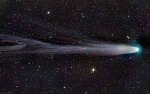 The Tail of a Christmas Comet
25.12.2021
The tail of a comet streams across this three degree wide telescopic field of view captured under dark Namibian skies on December 21. In outburst only a few days ago and just reaching naked eye visibility Comet Leonard (C/2021 A1) is this year's brightest comet.
 APOD: 2025 December 7 Б The Sun and Its Missing Colors
7.12.2025
It is still not known why the Sun's light is missing some colors. Here are all the visible colors of the Sun, produced by passing the Sun's light through a prism-like device.
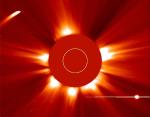 Sunbather
11.01.2002
Intense and overwhelming, the direct glare of the Sun is blocked by the smooth disk centered in this image from the sun-staring SOHO spacecraft. Taken on January 8, the picture shows streamers of solar wind billowing radially outward for millions of kilometers above the Sun's surface indicated by the white circle.
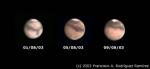 Mars Through a Small Telescope
19.08.2003
How does Mars appear through a small telescope? Viewed with the unaided eye or through a small telescope, possibly the most striking part of Mars' appearance is it's red color. The color derives from rust, iron oxide, which composes perhaps 10% of the Martian soil.
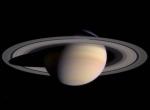 Eyeful of Saturn
30.04.2004
Now a bright speck of light wandering through Earth's night sky, magnificent planet Saturn lies nearly 1.5 billion kilometers from the Sun. But after an interplanetary voyage of seven years the planet's stunning rings nearly fill the field of the Cassini spacecraft's narrow angle camera in this image recorded on March 27.
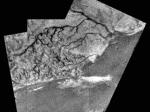 Riverbeds and Lakebeds Discovered on Saturn's Titan
24.01.2005
Methane rain, evaporating lakes, flowing rivers, and water ice-volcanoes all likely exist on Saturn's moon Titan, according to preliminary analyses of recent images taken by the successful Huygen's lander. A snaking...
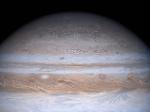 Jupiters Clouds from Cassini
11.09.2005
Gas giant Jupiter is the solar system's largest world with about 320 times the mass of planet Earth. Famous for its Great Red Spot, Jupiter is also known for its regular, equatorial cloud bands, visible in very modest sized telescopes.
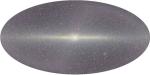 The Near Infrared Sky
18.05.2000
Was this picture taken from outside our Galaxy? No, it is a composite taken from Earth orbit, well inside our Milky Way Galaxy. In light just a little too red for human eyes...
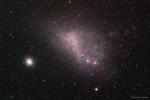 APOD: 2007 October 1- The Small Cloud of Magellan
1.10.2007
Portuguese navigator Ferdinand Magellan and his crew had plenty of time to study the southern sky during the first circumnavigation of planet Earth. As a result, two celestial wonders easily visible for southern hemisphere skygazers are known as the Clouds of Magellan.
 Spitzer s Milky Way
5.06.2008
The Spitzer Space Telescope's encompasing infrared view of the plane of our Milky Way Galaxy is hard to appreciate in just one picture. In fact, more than 800,000 frames of data from...
|
January February March April May June July August September October |
|||||||||||||||||||||||||||||||||||||||||||||||||