
|
You entered: light
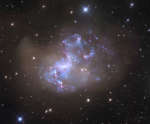 Unusual Starburst Galaxy NGC 1313
30.03.2010
Why is this galaxy so discombobulated? Usually, galaxies this topsy-turvy result from a recent collision with a neighboring galaxy. Spiral galaxy NGC 1313, however, appears to be alone. Brightly lit with new and blue massive stars, star formation appears so rampant in NGC 1313 that it has been labeled a starburst galaxy.
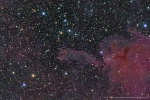 Cometary Globule CG4
5.03.2015
The faint and somehow menacing cometary globule CG4 reaches through the center of this deep southern skyscape. About 1,300 light-years from Earth toward the constellation Puppis, its head is about 1.5 light-years in diameter and its tail about 8 light-years long.
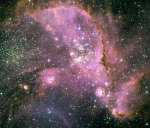 Young Stars of NGC 346
12.05.2022
The massive stars of NGC 346 are short lived, but very energetic. The star cluster is embedded in the largest star forming region in the Small Magellanic Cloud, some 210,000 light-years distant. Their...
 Hydrogen Trifid
28.08.1998
Clouds of glowing hydrogen gas mingle with dark dust lanes in the Trifid Nebula, a star forming region in the constellation Sagittarius. In this and other similar emission nebulae, energetic ultraviolet light from an embedded hot young star strips electrons from the surrounding hydrogen atoms.
 April s Moon and the Pleiades
14.04.2005
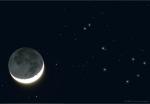
After parting with the Sun late last week, April's moon graced the early evening sky. Its slender, three-day-old crescent shares this lovely telescopic skyview with the nearby Pleiades star cluster. Here, the Moon...
 Aurora Over Alaska
6.10.2010
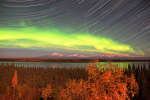
Are those green clouds or aurora? Photographed above two weeks ago, puffy green aurora help the Moon illuminate the serene Willow Lake and the snowy Wrangell and Saint Elias Mountains in eastern Alaska, USA.
 IC 59 and IC 63 in Cassiopeia
26.10.2018
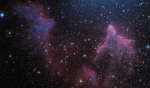
These bright rims and flowing shapes look ghostly on a cosmic scale. A telescopic view toward the constellation Cassiopeia, the colorful (zoomable) skyscape features the swept-back, comet-shaped clouds IC 59 (left) and IC 63.
 Star Forming Region S106
20.02.2001
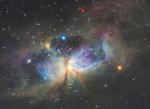
Massive star IRS4 is beginning to spread its wings. Born only about 100,000 years ago, material streaming out from this newborn star has formed the nebula dubbed Sharpless 106 Nebula (S106), pictured above.
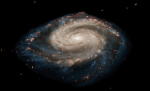 Virtual Flyby of the Whirlpool Galaxy
6.05.2019
What would it look like to fly over a spiral galaxy? To help visualize this, astronomers and animators at the Space Telescope Science Institute computed a virtual flyby of the Whirlpool Galaxy (M51) using data and images from the Hubble Space Telescope.
 APOD: 2025 October 28 Б NGC 6995: The Bat Nebula
28.10.2025
Can you see the bat? It haunts this cosmic close-up of the eastern Veil Nebula. The Veil Nebula itself is a large supernova remnant, the expanding debris cloud from the death explosion of a massive star.
|
January February March April May June July August September October |
|||||||||||||||||||||||||||||||||||||||||||||||||