
|
You entered: light
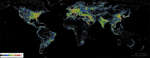 APOD: 2023 March 8 Б Artificial Night Sky Brightness
8.03.2023
Where have all the dim stars gone? From many places on the Earth including major cities, the night sky has been reduced from a fascinating display of thousands of stars to a diffuse glow through which only a few stars are visible.
 APOD: 2024 July 22 Б Chamaeleon Dark Nebulas
22.07.2024
Sometimes the dark dust of interstellar space has an angular elegance. Such is the case toward the far-south constellation of Chamaeleon. Normally too faint to see, dark dust is best known for blocking visible light from stars and galaxies behind it.
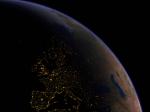 Europe at Night
7.12.2005
Can you find your favorite European city? The above digital fantasy of Europe at Night is a digital composite of archived satellite images taken both during the day and night. This image is different...
 APOD: 2026 March 11 Б CG 4: The Globule and the Galaxy
11.03.2026
Is this a cosmic monster ready to devour an unsuspecting galaxy? Thankfully, that is not the case. The red БmonsterБ shown in the featured image is Cometary Globule CG 4, 1,300 light-years away in the Constellation Puppis.
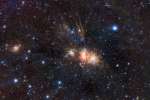 Vista with NGC 2170
15.10.2010
Drifting through the one-horned constellation Monoceros, these dusty streamers and new born stars are part of the active Monoceros R2 star-forming region, embedded in a giant molecular cloud. The cosmic scene was recorded by the VISTA survey telescope in near-infrared light.
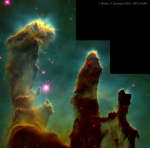 M16: Pillars of Star Creation
24.04.2016
Newborn stars are forming in the Eagle Nebula. This image, taken with the Hubble Space Telescope in 1995, shows evaporating gaseous globules (EGGs) emerging from pillars of molecular hydrogen gas and dust. The giant pillars are light years in length and are so dense that interior gas contracts gravitationally to form stars.
 M13: The Great Globular Cluster in Hercules
12.05.2017
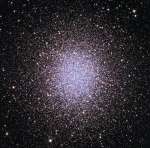
In 1716, English astronomer Edmond Halley noted, "This is but a little Patch, but it shews itself to the naked Eye, when the Sky is serene and the Moon absent." Of course...
 M16: A Star Forming Pillar from Webb
6.12.2022
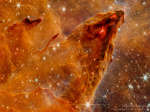
WhatБs happening inside this interstellar mountain? Stars are forming. The mountain is actually a column of gas and dust in the picturesque Eagle Nebula (M16). A pillar like this is so low in density that you could easily fly though it -- it only appears solid because of its high dust content and great depth.
 APOD: 2024 December 17 Б Near to the Heart Nebula
17.12.2024
What excites the Heart Nebula? First, the large emission nebula on the upper left, catalogued as IC 1805, looks somewhat like a human heart. The nebula glows brightly in red light emitted by its most prominent element, hydrogen, but this long-exposure image was also blended with light emitted by sulfur (yellow) and oxygen (blue).
 Ice Fishing for Cosmic Neutrinos
29.04.2001
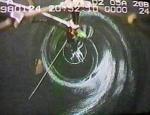
Scientists are melting holes in the bottom of the world. In fact, several holes have been melted near the South Pole, and they are now being used as astronomical observatories. Astronomers with the Antarctic Muon and Neutrino Detector Array (AMANDA) lower into each vertical lake a string knotted with basketball-sized light detectors.
|
January February March April May June July August September October |
|||||||||||||||||||||||||||||||||||||||||||||||||