
|
You entered: light
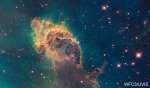 Carina Nebula Dust Pillar
7.02.2015
This cosmic pillar of gas and dust is nearly two light-years wide. The structure lies within one of our galaxy's largest star forming regions, the Carina Nebula, shining in southern skies at a distance of about 7,500 light-years.
 Star Factory Messier 17
8.09.2023
Sculpted by stellar winds and radiation, the star factory known as Messier 17 lies some 5,500 light-years away in the nebula-rich constellation Sagittarius. At that distance, this 1/3 degree wide field of view spans over 30 light-years.
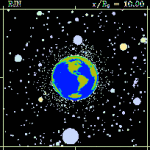 Neutron Star Earth
16.06.1995
If the Earth could somehow be transformed to the ultra-high density of a neutron star , it might appear as it does in the above computer generated figure. Due to the very strong gravitational field, the neutron star distorts light from the background sky greatly. If you look closely, two
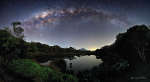 Milky Way Over Piton de lEau
25.06.2012
Sometimes, if you wait long enough for a clear and moonless night, the stars will come out with a vengeance. One such occasion occurred earlier this month at the Piton de l'Eau on Reunion Island. In the foreground, surrounded by bushes and trees, lies a water filled volcanic crater serenely reflecting starlight.
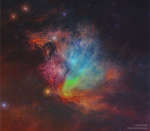 APOD: 2023 February 19 Б Seven Dusty Sisters in Infrared
19.02.2023
Is this really the famous Pleiades star cluster? Known for its iconic blue stars, the Pleiades is shown here in infrared light where the surrounding dust outshines the stars. Here three infrared colors have been mapped into visual colors (R=24, G=12, B=4.6 microns).
 SWAN, Swan, Eagle
23.10.2025
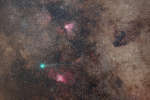
Comet C/2025 R2 (SWAN) sports a greenish coma and fainter tail, seen against congeries of stars and dusty interstellar clouds in this 7 degree wide telescopic field of view from October 17. On that...
 Webb's Rho Ophiuchi
25.10.2025
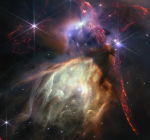
A mere 390 light-years away, Sun-like stars and future planetary systems are forming in the Rho Ophiuchi molecular cloud complex, the closest star-forming region to our fair planet. The James Webb Space Telescope's NIRCam peered into the nearby natal chaos to capture this infrared image at an inspiring scale.
 APOD: 2025 November 3 Б A Double Helix Lunar Eclipse
3.11.2025
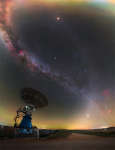
The image was timed to capture a total lunar eclipse -- but it came with quite a twist. First, the eclipse: the fully Earth-shadowed Moon is visible as the orange orb near the top.
 Stars and Dust Through Baades Window
23.12.2002
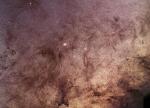
Billions of stars light up the direction toward the center of our Galaxy. The vast majority of these stars are themselves billions of years old, rivaling their home Milky Way Galaxy in raw age. These stars are much more faint and red than the occasional young blue stars that light up most galaxies.
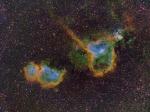 The Heart and Soul Nebulas
10.08.2005
Is the heart and soul of our Galaxy located in Cassiopeia? Possibly not, but that is where two bright emission nebulas nicknamed Heart and Soul can be found. The Heart Nebula, officially dubbed IC 1805 and visible above on the right, has a shape reminiscent of a classical heart symbol.
|
January February March April May June July August September October |
|||||||||||||||||||||||||||||||||||||||||||||||||