
|
You entered: light
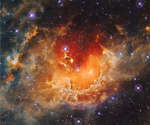 Star Formation in the Tadpole Nebula
17.11.2014
Dusty emission in the Tadpole nebula, IC 410, lies about 12,000 light-years away in the northern constellation Auriga. The cloud of glowing gas is over 100 light-years across, sculpted by stellar winds and radiation from embedded open star cluster NGC 1893.
 The Great Globular Cluster in Hercules
26.09.2024
In 1716, English astronomer Edmond Halley noted, "This is but a little Patch, but it shows itself to the naked Eye, when the Sky is serene and the Moon absent." Of course...
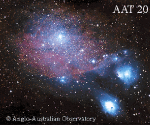 Nebulosity in Sagittarius
18.07.1996
What causes the colors in this beautiful nebulosity in Sagittarius? Dubbed NGC 6589 and NGC 6590, the colors of this nebulosity, are caused by gas and dust. The blue color of the nebula nearest the bright stars is caused by reflection off interstellar dust.
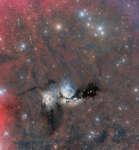 M78 Wide Field
21.01.2021
Interstellar dust clouds and glowing nebulae abound in the fertile constellation of Orion. One of the brightest, M78, is centered in this colorful, wide field view, covering an area north of Orion's belt. At a distance of about 1,500 light-years, the bluish reflection nebula is around 5 light-years across.
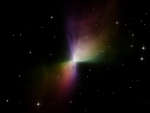 A Beautiful Boomerang Nebula
28.12.2007
This symmetric cloud dubbed the Boomerang Nebula was created by a high-speed wind of gas and dust blowing from an aging central star at speeds of nearly 600,000 kilometers per hour. The rapid...
 IC 1396 Close Up
30.09.2005
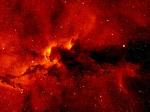
Clouds of glowing hydrogen gas mingle ominously with dark dust lanes in this close-up of IC 1396, an active star forming region some 2,000 light years away in the constellation Cepheus. In this and other similar emission nebulae, energetic ultraviolet light from a hot young star strips electrons from the surrounding hydrogen atoms.
 Herschel s Cocoon
19.08.2011
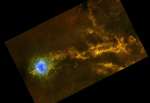
In this remarkable infrared skyscape of interstellar clouds adrift in the high flying constellation Cygnus, the eye is drawn to the Cocoon Nebula. Also known as IC5146, the dusty star forming region is shown...
 The Protoplanetary Disk of HL Tauri from ALMA
9.11.2014
Why does this giant disk have gaps? The exciting and probable answer is: planets. A mystery is how planets massive enough to create these gaps formed so quickly, since the HL Tauri star system is only about one million years old.
 M13: The Great Globular Cluster in Hercules
20.05.2021
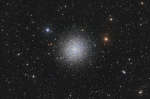
In 1716, English astronomer Edmond Halley noted, "This is but a little Patch, but it shews itself to the naked Eye, when the Sky is serene and the Moon absent." Of course...
 APOD: 2024 September 24 Б NGC 6727: The Rampaging Baboon Nebula
24.09.2024
This dusty region is forming stars. Part of a sprawling molecular cloud complex that resembles, to some, a rampaging baboon, the region is a relatively close by 500 light-years away toward the constellation Corona Australis. That's about one third the distance of the more famous stellar nursery known as the Orion Nebula.
|
January February March April May June July August September October |
|||||||||||||||||||||||||||||||||||||||||||||||||