
|
You entered: light
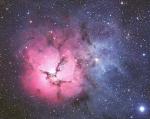 The Trifid Nebula from AAO
24.04.2002
Unspeakable beauty and unimaginable bedlam can be found together in the Trifid Nebula. Also known as M20, this photogenic nebula is visible with good binoculars towards the constellation of Sagittarius. The energetic processes of star formation create not only the colors but the chaos. The red-glowing gas results from high-energy starlight striking interstellar hydrogen gas.
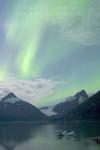 Aurora Over the Chugach Mountains
29.09.2003
Auroras can make spectacular sights. Photographed above, flowing green auroras help the Moon illuminate the serene Portage Lake and the snowy Chugach Mountains near Anchorage, Alaska, USA. Although auroras might first appear to be moonlit clouds, they only add light to the sky and do not block background stars from view.
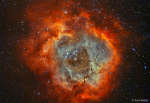 The Rosette Nebula in Hydrogen and Oxygen
24.02.2015
The Rosette Nebula is not the only cosmic cloud of gas and dust to evoke the imagery of flowers -- but it is the most famous. At the edge of a large molecular cloud...
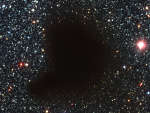 Molecular Cloud Barnard 68
23.03.2008
Where did all the stars go? What used to be considered a hole in the sky is now known to astronomers as a dark molecular cloud. Here, a high concentration of dust and molecular gas absorb practically all the visible light emitted from background stars.
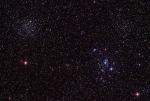 Star Clusters Young and Old
10.09.2006
Many stars form in clusters. Galactic or open star clusters are relatively young swarms of bright stars born together near the plane of our Milky Way Galaxy. Separated by about a degree...
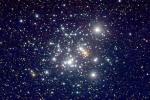 NGC 4755: A Jewel Box of Stars
18.06.2001
The great variety of star colors in this open cluster underlie its name: The Jewel Box. One of the bright central stars is a red supergiant, in contrast to the many blue stars that surround it. The cluster, also known as Kappa Crucis contains just over 100 stars, and is about 10 million years old.
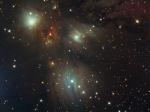 Still Life with NGC 2170
3.03.2005
In this beautiful celestial still life composed with a cosmic brush, dusty nebula NGC 2170 shines at the upper left. Reflecting the light of nearby hot stars, NGC 2170 is joined by other bluish reflection nebulae and a compact red emission region against a backdrop of stars.
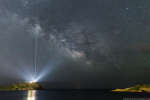 The Milky Way over the Temple of Poseidon
8.06.2015
What's that glowing in the distance? Although it may look like a lighthouse, the rays of light near the horizon actually emanate from the Temple of Poseidon at Cape Sounion, Greece. Some temple lights are even reflected in the Aegean Sea in the foreground.
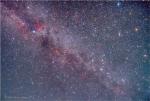 The Northern Milky Way
25.08.2003
Many of the stars in our home Milky Way Galaxy appear together as a dim band on the sky that passes nearly over the Earth's north and south poles. Pictured above is the part of our Galaxy that passes closest over the north pole.
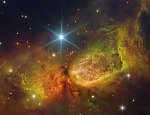 Star Forming Region S106
7.11.2011
Massive star IRS 4 is beginning to spread its wings. Born only about 100,000 years ago, material streaming out from this newborn star has formed the nebula dubbed Sharpless 2-106 Nebula (S106), pictured above.
|
January February March April May June July August September October |
|||||||||||||||||||||||||||||||||||||||||||||||||