
|
You entered: light
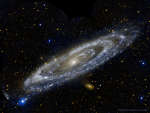 The Andromeda Galaxy in Ultraviolet
18.07.2021
What does the Andromeda galaxy look like in ultraviolet light? Young blue stars circling the galactic center dominate. A mere 2.5 million light-years away, the Andromeda Galaxy, also known as M31, really is just next door as large galaxies go.
 Stars and Dust Across Corona Australis
3.04.2006
A cosmic dust cloud sprawls across a rich field of stars in this gorgeous wide field telescopic vista looking toward Corona Australis, the Southern Crown. Probably less than 500 light-years away and effectively blocking...
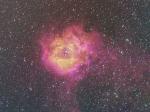 The Rosette Nebula
14.02.2005
Would the Rosette Nebula by any other name look as sweet? The bland New General Catalog designation of NGC 2237 doesn't appear to diminish the appearance of the this flowery emission nebula. Inside the nebula lies an open cluster of bright young stars designated NGC 2244.
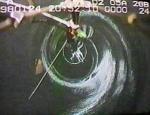 Ice Fishing for Cosmic Neutrinos
17.03.1999
In 1996, scientists melted a hole in the bottom of the world. In fact, several holes have been melted near the South Pole, and they are now being used as astronomical observatories. Astronomers with the Antarctic Muon and Neutrino Detector Array (AMANDA) lower into each vertical lake a string knotted with basketball-sized light detectors.
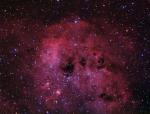 IC 410 and NGC 1893
15.08.2006
A faint, dusty rose of the northern sky, emission nebula IC 410 lies about 12,000 light-years away in the constellation Auriga. The cloud of glowing hydrogen gas is over 100 light-years across, sculpted by stellar winds and radiation from embedded open star cluster NGC 1893.
 Mars and the Beehive
10.06.2023
This month, bright Mars and brilliant Venus are the prominent celestial beacons in planet Earth's western skies after sunset. Wandering through the constellation Cancer the Crab, the Red Planet was captured here on the evening of June 3 near the stars of open cluster Messier 44.
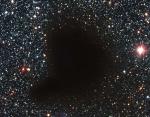 Molecular Cloud Barnard 68
2.02.2003
Where did all the stars go? What used to be considered a hole in the sky is now known to astronomers as a dark molecular cloud. Here, a high concentration of dust and molecular gas absorb practically all the visible light emitted from background stars.
 Massive Star Forming Region DR21 in Infrared
14.04.2004
Deep in the normally hidden recesses of giant molecular cloud DR21, a stellar nursery has been found creating some of the most massive stars yet recorded. The orbiting Spitzer Space Telescope's Infrared Array Camera opened the window into the cloud last year in mid- infrared light.
 APOD: 2025 November 2 Б A Horseshoe Einstein Ring from Hubble
2.11.2025
What's large and blue and can wrap itself around an entire galaxy? A gravitational lens mirage. Pictured here, the gravity of a massive elliptical galaxy (luminous red galaxy: LRG) has gravitationally distorted the light from a much more distant blue galaxy.
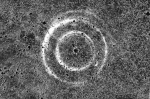 The Expanding Echoes of Supernova 1987A
24.02.2019
Can you find supernova 1987A? It isn't hard -- it occurred at the center of the expanding bullseye pattern. Although this stellar detonation was first seen in 1987, light from SN 1987A continued to bounce off clumps of interstellar dust and be reflected to us even many years later.
|
January February March April May June July August September October |
|||||||||||||||||||||||||||||||||||||||||||||||||