
|
You entered: Earth
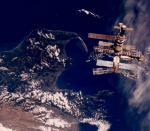 Mir Dreams
18.02.2006
This dream-like image of Mir was recorded by astronauts as the space shuttle orbiter Atlantis approached the Russian space station prior to docking during the STS-76 mission in 1996. Sporting spindly appendages and solar...
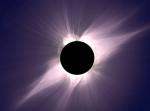 Solar Surfin
16.07.1999
The sun's corona is a tenuous outer atmosphere composed of streams of energetic charged particles, but it is only easily seen from Earth during a total solar eclipse. For example, this 1991 image of totality from atop Mauna Kea, Hawaii forms a fleeting snapshot of the mysterious corona's beautiful, intricate structures and streams.
 Planetary Nebula NGC 2440
15.02.2007
Planetary nebula NGC 2440 has an intriguing bow-tie shape in this stunning view from space. The nebula is composed of material cast off by a dying sun-like star as it enters its white dwarf phase of evolution.
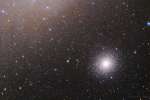 47 Tuc Near the Small Magellanic Cloud
6.12.2012
Globular star cluster 47 Tucanae is a jewel of the southern sky. Also known as NGC 104, it roams the halo of our Milky Way Galaxy along with around 200 other globular star clusters.
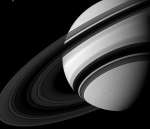 Saturns Rings from the Dark Side
31.12.2012
What do Saturn's rings look like from the dark side? From Earth, we usually see Saturn's rings from the same side of the ring plane that the Sun illuminates them -- one might call this the bright side.
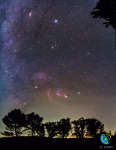 Comet Lovejoy in a Winter Sky
27.01.2015
Which of these night sky icons can you find in this beautiful and deep exposure of the northern winter sky? Skylights include the stars in Orion's belt, the Orion Nebula, the Pleiades star cluster, the bright stars Betelgeuse and Rigel, the California Nebula, Barnard's Loop, and Comet Lovejoy.
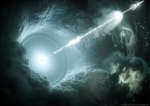 Neutrino Associated with Distant Blazar Jet
16.07.2018
With equipment frozen deep into ice beneath Earth's South Pole, humanity appears to have discovered a neutrino from far across the universe. If confirmed, this would mark the first clear detection of cosmologically-distant...
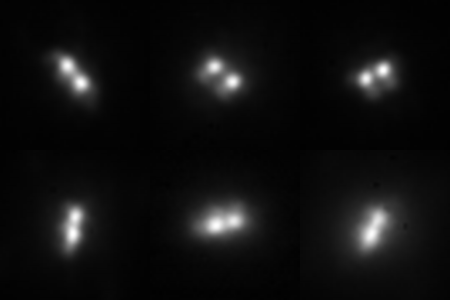 Double Asteroid 90 Antiope
1.11.2000
This eight-frame animation is based on the first ever images of a double asteroid! Formerly thought to be a single enormous chunk of rock, asteroid 90 Antiope resides in the solar system's main asteroid belt between Mars and Jupiter.
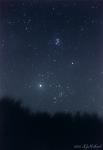 September Sky
29.09.2000
Star clusters, planets, and a red giant posed for this portrait of the night sky from rural Jasper County, Iowa, USA. Astrophotographer Stan Richard recorded the four minute time exposure looking east around midnight on September 3rd at Ashton-Wildwood Park.
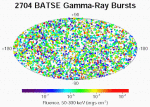 BATSE GRB Final Sky Map
28.06.2000
What causes the most powerful explosions in the universe? The BATSE modules that flew on the Compton Gamma Ray Observatory allowed more insight into enigmatic gamma-ray burst (GRB) explosions than ever before. From 1991-2000, BATSE detected 2704 GRBs, much more than ever previously recorded.
|
January February March April May June July August September October |
|||||||||||||||||||||||||||||||||||||||||||||||||