
|
You entered: Earth
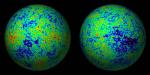 A Year of Resolving Cosmology
31.12.2003
This year, humanity learned that the universe is 13.7 billion years old. Before this year, the universe's age was thought to be about 13 billion years, but really only constrained to be between about 12 billion and 15 billion years old.
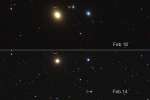 Vesta Near Opposition
18.02.2010
Main belt asteroid 4 Vesta is at its brightest now. The small world is near opposition (opposite the Sun in the sky) and closest to Earth. But even at its brightest, Vesta is just too faint to spot with the naked-eye.
 Opportunity at Santa Maria Crater
29.01.2011
Celebrating 7 years on the surface of the Red Planet, Mars exploration rover Opportunity now stands near the rim of 90 meter wide Santa Maria crater. Remarkably, Opportunity and its fellow rover Spirit were initially intended for a 3 month long primary mission.
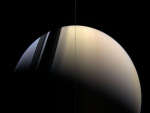 Saturn in Blue and Gold
13.04.2014
Why is Saturn partly blue? The above picture of Saturn approximates what a human would see if hovering close to the giant ringed world. The above picture was taken in 2006 March by the robot Cassini spacecraft now orbiting Saturn. Here Saturn's majestic rings appear directly only as a thin vertical line.
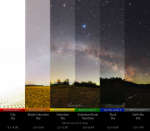 Country Sky versus City Sky
8.04.2020
Dark skies are disappearing from the world. With modernization comes artificial lighting that brightens the night. While these lights allow modern humans to see, much light is wasted up into the sky. This light...
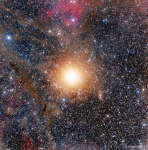 Behind Betelgeuse
11.05.2020
What's behind Betelgeuse? One of the brighter and more unusual stars in the sky, the red supergiant star Betelgeuse can be found in the direction of famous constellation Orion. Betelgeuse, however, is actually...
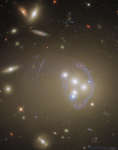 Abell 3827: Cannibal Cluster Gravitational Lens
23.08.2021
Is that one galaxy or three? Toward the right of the featured Hubble image of the massive galaxy cluster Abell 3827 is what appears to be a most unusual galaxy -- curved and with three centers.
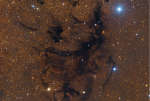 LDN 673: Dark Clouds in Aquila
29.10.2022
Part of a dark expanse that splits the crowded plane of our Milky Way galaxy, the Aquila Rift arcs through planet Earth's skies near bright star Altair. In eerie silhouette against the Milky...
 APOD: 2023 July 11 Б Sunspots on an Active Sun
11.07.2023
Why is our Sun so active now? No one is sure. An increase in surface activity was expected because our Sun is approaching solar maximum in 2025. However, last month our Sun sprouted more sunspots than in any month during the entire previous 11-year solar cycle -- and even dating back to 2002.
 APOD: 2025 February 3 Б Wolf Rayet Star 124: Stellar Wind Machine
3.02.2025
Some stars explode in slow motion. Rare, massive Wolf-Rayet stars are so tumultuous and hot that they are slowly disintegrating right before our telescopes. Glowing gas globs each typically over 30 times more massive than the Earth are being expelled by violent stellar winds.
|
January February March April May June July August September October |
|||||||||||||||||||||||||||||||||||||||||||||||||