
|
You entered: Earth
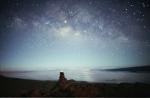 Moonlight, Mars and Milky Way
27.06.2001
Aloha and welcome to a breath-taking skyscape. In this celestial scene, a four day old Moon illuminates a dreamlike foreground while bright planet Mars (above center) rules and the Milky Way's cosmic clouds of stars and dust seem to stretch from horizon to horizon.
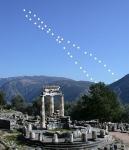 Sunrise Analemma
20.03.2003
Astronomically speaking, at the Equinox on March 21, 01:00 UT (March 20, 8:00 PM ET) the season changes. For this Equinox the Sun rises due east as it crosses the celestial equator heading north. In celebration, consider this spectacular sunrise analemma!
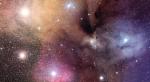 The Colorful Clouds of Rho Ophiuchi
2.06.2004
The many spectacular colors of the Rho Ophiuchi (oh'-fee-yu-kee) clouds highlight the many processes that occur there. The blue regions shine primarily by reflected light. Blue light from the star Rho Ophiuchi and nearby stars reflects more efficiently off this portion of the nebula than red light.
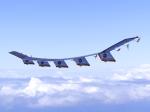 The Flight Of Helios
22.07.2007
An example of solar-powered flight, NASA's Helios aircraft flew almost one hundred years after the Wright brothers' historic flight on December 17, 1903. Pictured here at 10,000 feet in in skies northwest of Kauai, Hawaii in August 2001, the remotely piloted Helios is traveling at about 25 miles per hour.
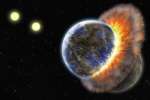 The Case of the Very Dusty Binary Star
25.09.2008
For astronomers, close binary star system BD+20 307 originally stood out because it is extremely dusty. A substantial amount of warm dust surrounding it causes the system to appear exceptionally bright at infrared wavelengths. Of course, dust associated with planet formation is often detected around young stars, stars only a few million years old.
 Welcome to the International Year of Astronomy
1.01.2009
Astronomers all over planet Earth invite you to experience the night sky as part of the International Year of Astronomy 2009. This year was picked by the International Astronomical Union and the United Nations Educational, Scientific, and Cultural Organization because it occurs 400 years after Galileo turned one of the first telescopes toward the heavens.
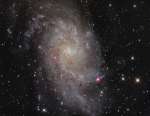 M33: Triangulum Galaxy
3.12.2010
The small, northern constellation Triangulum harbors this magnificent face-on spiral galaxy, M33. Its popular names include the Pinwheel Galaxy or just the Triangulum Galaxy. M33 is over 50,000 light-years in diameter, third largest in the Local Group of galaxies after the Andromeda Galaxy (M31), and our own Milky Way.
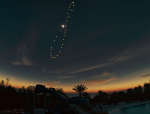 Tutulemma: Solar Eclipse Analemma
22.12.2013
If you went outside at exactly the same time every day and took a picture that included the Sun, how would the Sun's position change? With great planning and effort, such a series of images can be taken. The figure-8 path the Sun follows over the course of a year is called an analemma.
 Dark Skies: Turn on the Night
16.05.2019
Have you ever experienced a really dark night sky? One common and amazing feature is the glowing band of our Milky Way galaxy stretching from horizon to horizon. If you live in or near...
 Apollo 11 Launches Humans to the Moon
16.07.2019
Everybody saw the Moon. Nobody had ever been there. Humans across planet Earth watched in awe 50 years ago today as a powerful Saturn V rocket attempted to launch humans -- to the Moon. Some...
|
January February March April May June July August September October |
|||||||||||||||||||||||||||||||||||||||||||||||||