
|
You entered: light
 APOD: 2024 February 21 Б Seagull Nebula over Pinnacles Peak
21.02.2024
The bird is bigger than the peak. Nicknamed for its avian shape, the Seagull Nebula is an emission nebula on the night sky that is vast, spanning an angle over five times the diameter of the full moon and over 200 light years.
 Painting with Jupiter
19.04.2025
In digital brush strokes, Jupiter's signature atmospheric bands and vortices were used to form this interplanetary post-impressionist work of art. The creative image from citizen scientist Rick Lundh uses data from the Juno spacecraft's JunoCam.
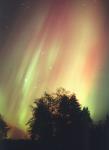 October Skylights
8.11.2000
With brilliant Venus above the western horizon at sunset and Jupiter and Saturn high in the east by early evening, November's night sky is filled with bright planets. October's sky featured bright planets as well and, triggered by the active Sun, some lovely auroral displays.
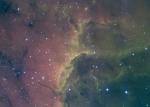 Pelican Nebula Ionization Front
3.07.2000
The Pelican Nebula is slowly being transformed. IC 5070, the official designation, is divided from the larger North America Nebula by a molecular cloud filled with dark dust. The Pelican, however, receives much study because it is a particularly active mix of star formation and evolving gas clouds.
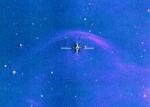 Runaway Star
3.12.1997
Runaway stars are massive stars traveling rapidly through interstellar space. Like a ship plowing through the interstellar medium, runaway star HD 77581 has produced this graceful arcing bow wave or "bow shock" - compressing the gaseous material in its path.
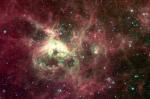 The Tarantula Nebula from Spitzer
2.02.2004
In the heart of monstrous Tarantula Nebula lies one of the most unusual star clusters. Known as NGC 2070 or R136, it is home to a great number of hot young stars. The energetic light from these stars continually ionizes nebula gas, while their energetic particle wind blows bubbles and defines intricate filaments.
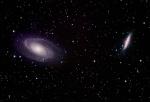 Galaxy Wars: M81 Versus M82
9.02.2000
In the left corner, wearing a red nucleus surrounded by blue spiral arms, is M81. In the right corner, sporting light stars and dark dust lanes, is M82. These two mammoth galaxies have been locked in gravitational combat for the past billion years.
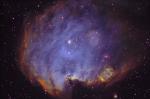 NGC 2174: Emission Nebula in Orion
8.12.2006
A lesser known sight in the nebula-rich constellation Orion, NGC 2174 can be found with binoculars near the head of the celestial hunter. About 6,400 light-years distant, the glowing cosmic cloud surrounds loose clusters of young stars.
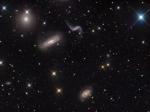 Galaxy Group Hickson 44
19.03.2007
Galaxies, like stars, frequently form groups. A group of galaxies is a system containing more than two galaxies but less than the tens or hundreds typically found in a cluster of galaxies. A most...
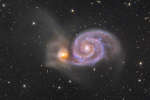 Whirlpool Galaxy Deep Field
26.05.2009
Follow the handle of the Big Dipper away from the dipper's bowl, until you get to the handle's last bright star. Then, just slide your telescope a little south and west and you might find this stunning pair of interacting galaxies, the 51st entry in Charles Messier's famous catalog.
|
January February March April May June July August September October |
|||||||||||||||||||||||||||||||||||||||||||||||||