
|
You entered: light
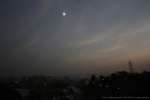 Eclipse over Chongqing, China
24.07.2009
The daytime sky grew dark, the temperature dropped, and lights came on as Chongqing, China, was plunged into the Moon's shadow during the July 22nd total solar eclipse. This serene, wide-angle view of the event looks to the east over the large, populous city from a newly constructed park.
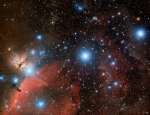 Alnitak, Alnilam, Mintaka
21.01.2011
Alnitak, Alnilam, and Mintaka, are the bright bluish stars from east to west (left to right) along the diagonal in this gorgeous cosmic vista. Otherwise known as the Belt of Orion, these three blue supergiant stars are hotter and much more massive than the Sun.
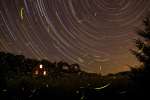 A Summer Night s Dream
5.08.2011
Fix your digital camera to a tripod, start a long series of exposures, and you too can record star trails. The concentric arcs traced by the stars as planet Earth rotates on its axis often produce dreamlike scenes in otherwise familiar situations. Fall asleep, though, and the results might surprise you.
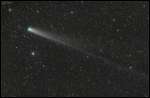 Lovejoy in the New Year
3.01.2014
A rival to vanquished Comet ISON in 2013, Comet Lovejoy (C/2013 R1) still sweeps through early morning skies, captured in this starry scene on New Year's day. The frame stretches some 3.5 degrees across a background of faint stars in the constellation Hercules.
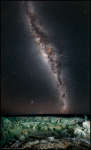 Southern Craters and Galaxies
26.12.2015
The Henbury craters in the Northern Territory, Australia, planet Earth, are the scars of an impact over 4,000 years old. When an ancient meteorite fragmented into dozens of pieces, the largest made the 180 meter diameter crater whose weathered walls and floor are lit in the foreground of this southern hemisphere nightscape.
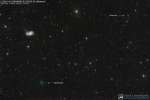 Whirlpool with Comets
8.12.2016
Not a comet, bright spiral galaxy Messier 51 is popularly known as the Whirlpool Galaxy. Just off the handle of the Big Dipper in northern skies, you can spot it at the upper left in this image from December 1st. The pretty 4 by 2.5 degree wide field of view does contain two comets though.
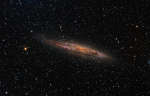 Nearby Spiral Galaxy NGC 4945
22.08.2019
Large spiral galaxy NGC 4945 is seen edge-on near the center of this cosmic galaxy portrait. In fact, it's almost the size of our Milky Way Galaxy. NGC 4945's own dusty disk, young blue star clusters, and pink star forming regions standout in the sharp, colorful telescopic image.
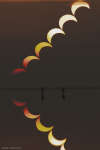 A Partial Solar Eclipse Sequence Reflected
27.12.2019
What's happened to the Sun? Yesterday, if you were in the right place at the right time, you could see the Sun rise partially eclipsed by the Moon. The unusual sight was captured...
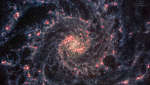 Spiral Galaxy M74: A Sharper View
22.07.2022
Beautiful spiral galaxy Messier 74 (also known as NGC 628) lies some 32 million light-years away toward the constellation Pisces. An island universe of about 100 billion stars with two prominent spiral arms, M74 has long been admired by astronomers as a perfect example of a grand-design spiral galaxy.
 Planet Earth at Night II
17.06.2023
Recorded during 2017, timelapse sequences from the International Space Station are compiled in this serene video of planet Earth at Night. Fans of low Earth orbit can start by enjoying the view as green and red aurora borealis slather up the sky.
|
January February March April May June July August September October |
|||||||||||||||||||||||||||||||||||||||||||||||||