
|
You entered: light
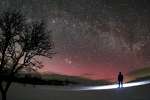 Comet of the North
5.04.2013
It looks like a double comet, but Comet PanSTARRS (C/2011 L4) is just offering skygazers a Messier moment. Outward bound and fading in this starry scene, the well-photographed comet is remarkably similar in brightness to M31, the Andromeda Galaxy.
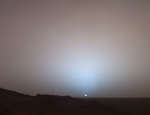 Martian Sunset
2.03.2014
What would it be like to see a sunset on Mars? To help find out, the robotic rover Spirit was deployed in 2005 to park and watch the Sun dip serenely below the distant lip of Gusev crater.
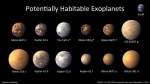 Habitable Worlds
3.03.2014
Is Earth the only known world that can support life? In an effort to find life-habitable worlds outside our Solar System, stars similar to our Sun are being monitored for slight light decreases that indicate eclipsing planets. Many previously-unknown planets are being found, including over 700 worlds recently uncovered by NASA's Kepler satellite.
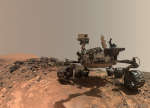 Curiosity Rover Takes Selfie on Mars
19.11.2017
Yes, but have you ever taken a selfie on Mars? The Curiosity rover on Mars has. This selfie was compiled from many smaller images -- which is why the mechanical arm holding the camera is not visible.
 Da Vinci Rise
25.09.2019
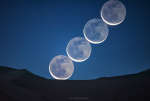
An old Moon rose this morning, its waning sunlit crescent shining just above the eastern horizon before sunrise. But earthshine, light reflected from a bright planet Earth, lit the shadowed portion of the lunar disk and revealed most of a familiar lunar near side to early morning risers.
 The Horsehead Nebula
5.10.2019
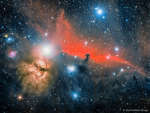
The Horsehead Nebula is one of the most famous nebulae on the sky. It is visible as the dark indentation to the red emission nebula in the center of the above photograph. The horse-head feature is dark because it is really an opaque dust cloud that lies in front of the bright red emission nebula.
 Dark Sky Reflections
28.06.2020
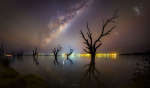
When the lake calmed down, many wonders of the land and sky appeared twice. Perhaps the most dramatic from the dark sky was the central band of our Milky Way Galaxy, visible as a diagonal band. Toward the right were both the Small (SMC) and Large (LMC) Magellanic Clouds, satellite galaxies of our Milky Way.
 APOD: 2024 November 25 Б The Horsehead Nebula
24.11.2024
One of the most identifiable nebulas in the sky, the Horsehead Nebula in Orion, is part of a large, dark, molecular cloud. Also known as Barnard 33, the unusual shape was first discovered on a photographic plate in the late 1800s.
 APOD: 2024 December 1 Б Cosmic Latte: The Average Color of the Universe
30.11.2024
What color is the universe? More precisely, if the entire sky were smeared out, what color would the final mix be? This whimsical question came up when trying to determine what stars are commonplace in nearby galaxies. The answer, depicted here, is a conditionally perceived shade of beige. In computer parlance: #FFF8E7.
 Hale-Bopp: The Crowd Pleaser Comet
9.07.1998
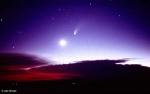
In 1997, the bright comet Hale-Bopp may have become the most viewed comet in history -- visible even to casual skywatchers in light polluted cities around the globe. In this picture, taken by photographer...
|
January February March April May June July August September October |
|||||||||||||||||||||||||||||||||||||||||||||||||