
|
You entered: light
 APOD: 2025 November 26 Б Globular Cluster M15 Deep Field
25.11.2025
Stars, like bees, swarm around the center of bright globular cluster M15. The central ball of over 100,000 stars is a relic from the early years of our Galaxy, and continues to orbit the Milky Way's center.
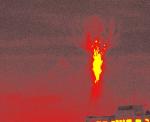 Burning Tree Sprite
2.08.2001
This dramatic, garishly colored image was captured with a low-light level camera on 2001 June 7. It shows what appears to be a "burning tree" above the National Cheng Kung University campus in Tainan City, Taiwan ... but the burning tree is actually a fleeting red sprite 300 kilometers away.
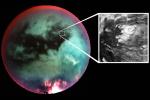 Titan s Cryovolcano
10.06.2005
Investigators suspect the domed feature detailed above is an ice volcano, or cryovolcano, seen in infrared light through the hazy atmosphere on Saturn's moon Titan. Since Titan's surface temperature is around -180...
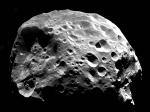 Phoebe: Comet Moon of Saturn
11.02.2006
Was Saturn's moon Phoebe once a comet? Images from the robotic Cassini spacecraft taken two years ago when entering the neighborhood of Saturn indicate that Phoebe may have originated in the outer Solar System.
 BLG 109: A Distant Version of our own Solar System
17.02.2008
How common are planetary systems like our own? Perhaps quite common, as the first system of planets like our own Solar System has been discovered using a newly adapted technique that, so far, has probed only six planetary systems.
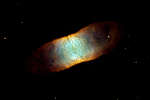 IC 4406: A Seemingly Square Nebula
27.07.2008
How can a round star make a square nebula? This conundrum comes to light when studying planetary nebulae like IC 4406. Evidence indicates that IC 4406 is likely a hollow cylinder, with its square appearance the result of our vantage point in viewing the cylinder from the side.
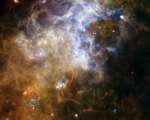 Herschel Views the Milky Way
16.10.2009
With a 3.5 meter diameter mirror, larger than the Hubble Space Telescope, Herschel is ESA's new infrared observatory. The space-based telescope is named for German-born British astronomer Frederick William Herschel who discovered infrared light over 200 years ago.
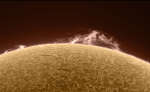 Reinvigorated Sun and Prominence
22.03.2010
Dramatic prominences can sometimes be seen looming just beyond the edge of the sun. Such was the case last week as a giant prominence, visible above on the right, highlighted a Sun showing increased activity as it comes off an unusually quiet Solar Minimum.
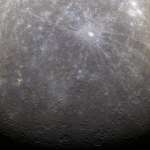 MESSENGER at Mercury
31.03.2011
On March 17, the MESSENGER spacecraft became the first to orbit Mercury, the solar system's innermost planet. This is its first processed color image since entering Mercury orbit. Larger, denser, and with almost twice the surface gravity of Earth's moon, Mercury still looks moon-like at first glance.
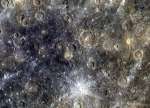 Mercury's Surface in Exaggerated Color
16.06.2011
The robotic MESSENGER spacecraft recently completed over 100 orbits of Mercury. Messenger's cameras have recorded detailed pictures utilizing eight different colors across visible and near infrared light, exploring the surface composition and looking for clues to the history and evolution of the solar system's innermost planet.
|
January February March April May June July August September October |
|||||||||||||||||||||||||||||||||||||||||||||||||