
|
You entered: light
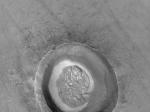 Brain Crater on Mars
19.05.2004
What caused this unusual looking crater floor on Mars? Appearing at first glance to resemble the human brain, the natural phenomena that created the unusual texture on the floor of this Martian impact crater are currently under investigation. The light colored region surrounding the brain-textured region is likely sand dunes sculpted by winds.
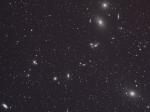 Markarians Chain of Galaxies
16.03.2005
Across the heart of the Virgo Cluster of Galaxies lies a striking string of galaxies known as Markarian's Chain. The chain, pictured above, is highlighted on the upper right with two large but featureless lenticular galaxies, M84 and M86, and connects to the large spiral on the lower left, M88.
 Mercury And The Sun
19.11.1999
Just days before the peak of the Leonid meteor shower, skywatchers were offered another astronomical treat as planet Mercury crossed the face of the Sun on November 15. Viewed from planet Earth, a transit of Mercury is not all that rare. The last occurred in 1993 and the next will happen in 2003.
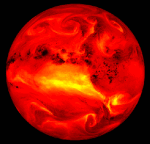 The Water Vapor Channel
4.09.1999
What alien planet's bizarre landscape lurks below these fiery-looking clouds? It's only Planet Earth, of course ... as seen on the Water Vapor Channel. Hourly, images like this one (an infrared image shown in false color) are brought to you by the orbiting Geostationary Operational Environmental Satellites' (GOES) multi-channel imagers.
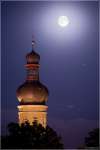 A Galilean Night
23.10.2009
Driving along on a summer evening, near the small town of Weikersheim in southern Germany, photographer Jens Hackmann had to stop. He couldn't resist pointing his camera and telephoto lens at this lovely conjunction of a Full Moon and planet Jupiter looming near the steeple of a local church.
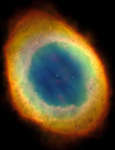 M57: The Ring Nebula
15.11.2009
It looks like a ring on the sky. Hundreds of years ago astronomers noticed a nebula with a most unusual shape. Now known as M57 or NGC 6720, the gas cloud became popularly known as the Ring Nebula.
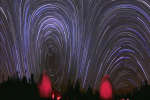 Warped Sky: Star Trails Panorama
11.07.2010
What's happened to the sky? A time warp, of sorts, and a digital space warp too. The time warp occurs because this image captured in a single frame a four hour exposure of the night sky. As a result, prominent star trails are visible.
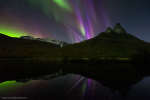 Aurora and Fireball Over Norway
5.10.2012
What's happening behind that mountain? A convergence of variable sky spectacles. One night in mid-September near TromsЬ, Norway, high red aurora could be seen shimmering through lower green aurora in a way that created a striking and somewhat unusual violet glow.
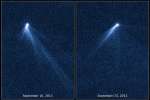 The Unexpected Tails of Asteroid P5
12.11.2013
What is happening to asteroid P/2013 P5? No one is sure. For reasons unknown, the asteroid is now sporting not one but six discernible tails. The above images were taken two months ago by the orbiting Hubble Space Telescope and show the rapidly changing dust streams.
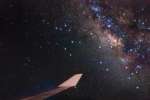 New York to London Milky Way
14.06.2014
Bright stars of Sagittarius and the center of our Milky Way Galaxy lie just off the wing of a Boeing 747 in this astronomical travel photo. The stratospheric scene was captured earlier this month during a flight from New York to London, 11,0000 meters above the Atlantic Ocean.
|
January February March April May June July August September October |
|||||||||||||||||||||||||||||||||||||||||||||||||