
|
You entered: light
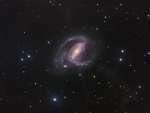 The Jets of NGC 1097
27.11.2009
Enigmatic spiral galaxy NGC 1097 lies about 45 million light-years away in the southern constellation Fornax. The small companion galaxy, just below and left of center, that seems to be wrapped in its spiral arms, is not NGC 1097's most peculiar feature though.
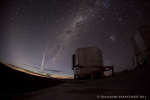 Comet Lovejoy over Paranal
28.12.2011
Comet Lovejoy (C/2011 W3) survived its close encounter with the Sun earlier this month, taking its place among wonders of the southern skies just in time for Christmas. Seen here before sunrise from Paranal Observatory in Chile, the sungrazing comet's tails stretch far above the eastern horizon.
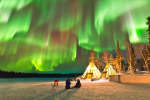 Auroras over Northern Canada
9.10.2022
Gusting solar winds and blasts of charged particles from the Sun resulted in several rewarding nights of auroras back in 2014 December, near the peak of the last 11-year solar cycle. The featured image captured dramatic auroras stretching across a sky near the town of Yellowknife in northern Canada.
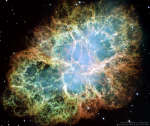 APOD: 2023 January 15 Б M1: The Crab Nebula from Hubble
15.01.2023
This is the mess that is left when a star explodes. The Crab Nebula, the result of a supernova seen in 1054 AD, is filled with mysterious filaments. The filaments are not only tremendously...
 A Baby Galaxy
24.03.1998
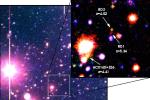
What's the farthest galaxy known? The answer keeps changing as astronomers compete to find new galaxies which top the list. The new record holder is now the faint red smudge indicated in the above image by the arrow.
 The Average Color of the Universe
2.07.2002
What color is the universe? More precisely, if the entire sky was smeared out, what color would the final mix be? This whimsical question came up when trying to determine what stars are commonplace in nearby galaxies. The answer, depicted above, is a conditionally perceived shade of beige.
 N11: A Giant Ring of Emission Nebulas
6.10.2004
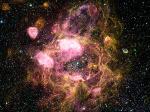
How did this unusually large nebula form? One of the largest nebulas yet detected is actually a complex ring of emission nebulas connected by glowing filaments. The unusual network, known as N11, spans over...
 Big Dipper Castle
18.02.2005
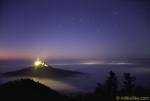
The stars of the big dipper, a well known asterism in the constellation Ursa Major, are easy to recognize in this dramatic skyscape. In fact, northern hemisphere skygazers often follow along the line indicated by the two stars at the far right.
 Orions Horsehead Nebula
21.03.2005
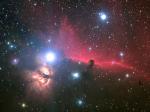
The Horsehead Nebula is one of the most famous nebulae on the sky. It is visible as the dark indentation to the red emission nebula seen above and to the right of center in the above photograph. The bright star on the left is located in the belt of the familiar constellation of Orion.
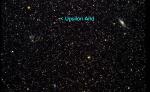 Where is Upsilon Andromedae
22.04.1999
Astronomers recently announced the detection of three large planets orbiting the star Upsilon Andromedae - the first planetary system known to orbit a normal star other than our Sun. These planets were not directly photographed but found through a Doppler technique developed to use large telescopes to search nearby stars for wobbling planetary signatures.
|
January February March April May June July August September October |
|||||||||||||||||||||||||||||||||||||||||||||||||