
|
You entered: light
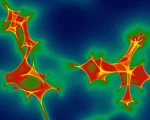 A Network of Microlensing Caustics
15.12.2002
A virtual sky map like this would be of interest to astronomers studying gravitational microlensing. In microlensing, the gravity of stars near the line of sight can act to magnify the light of background objects such as distant stars, or quasars. Nowhere is this magnification greater than near a gravitational lensing caustic.
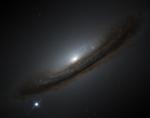 Supernova 1994D and the Unexpected Universe
30.12.1998
Far away, long ago, a star exploded. Supernova 1994D, visible as the bright spot on the lower left, occurred in the outskirts of disk galaxy NGC 4526. Supernova 1994D was not of interest for how different it was, but rather for how similar it was to other supernovae.
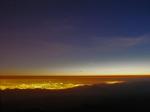 Three Planets from Mt Hamilton
30.06.2005
Venus, Mercury, and Saturn wandered close together in western evening skies last week. On Saturnday, June 25, astronomer R. Jay GaBany recorded this snapshot of their eye-catching planetary conjunction, from historic Lick Observatory on Mt. Hamilton, California, USA.
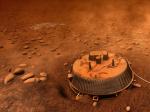 Huygens on Titan Illustrated
31.01.2006
If you could stand on Titan, what might you see? About one year ago the robotic Huygens probe landed on the enigmatic moon of Saturn and sent back the first ever images from beneath Titan's thick cloud layers.
 M57: The Ring Nebula
25.06.2006
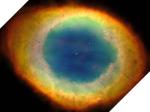
It looked like a ring on the sky. Hundreds of years ago astronomers noticed a nebula with a most unusual shape. Now known as M57 or NGC 6720, the gas cloud became popularly known as the Ring Nebula.
 Watch Jupiter Rotate
12.03.2007
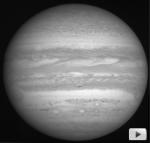
What would it be like to coast by Jupiter and watch it rotate? This was just the experience of the New Horizons spacecraft as it approached and flew by Jupiter earlier this year. Clicking on the image will bring up a movie of what the robotic spacecraft saw.
 Horizon to Horizon
21.12.2007
Scroll right and journey from horizon to horizon as your gaze sweeps through the zenith in the night sky over Beg-Meil, France. Recorded on December 13th, the entertaining panorama (image key) covers 210 degrees in 21 separate exposures, beginning on the beach with bright star Sirius rising in the southeast.
 Martian Sunset
10.01.2009
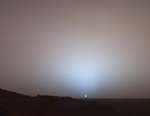
This month, the Mars Exploration Rovers are celebrating their 5th anniversary of operations on the surface of the Red Planet. The serene sunset view, part of their extensive legacy of images from the martian surface, was recorded by the Spirit rover on May 19, 2005.
 Blue Sun Bursting
20.05.2013
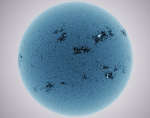
Our Sun is not a giant blueberry. Our Sun can be made to appear similar to the diminutive fruit, however, by imaging it in a specific color of extreme violet light called CaK that is emitted by the very slight abundance of ionized Calcium in the Sun's atmosphere, and then false color-inverting the image.
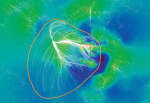 Laniakea: Our Home Supercluster of Galaxies
10.09.2014
It is not only one of the largest structures known -- it is our home. The just-identified Laniakea Supercluster of galaxies contains thousands of galaxies that includes our Milky Way Galaxy, the Local Group of galaxies, and the entire nearby Virgo Cluster of Galaxies.
|
January February March April May June July August September October |
|||||||||||||||||||||||||||||||||||||||||||||||||