
|
You entered: light
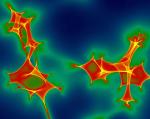 A Network of Microlensing Caustics
24.08.1999
A virtual sky map like this would be of interest to astronomers studying gravitational microlensing. In microlensing, the gravity of stars near the line of sight can act to magnify the light of background objects such as distant stars, or quasars. Nowhere is this magnification greater than near a gravitational lensing caustic.
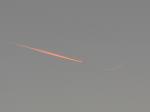 Jet Approaching a Crescent Moon
5.06.2007
No natural clouds appear in this picture. On the left, an airplane cruises through the atmosphere leaving a contrail in its wake. The contrail would normally appear white, but the large volume of air toward the setting Sun preferentially knocks away blue light, giving the reflected trail a bright orange hue.
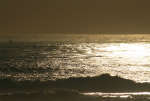 Fata Morgana: A Possibly Titanic Mirage
15.04.2012
Did this mirage help sink the Titanic? The optical phenomenon called Fata Morgana can make strange shapes or a false wall of water appear above a watery horizon. When conditions are right, light reflecting...
 Saturns Moon Helene in Color
2.05.2012
Although its colors may be subtle, Saturn's moon Helene is an enigma in any light. The moon was imaged in unprecedented detail last June as the robotic Cassini spacecraft orbiting Saturn swooped to within a single Earth diameter of the diminutive moon.
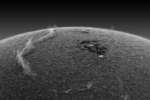 A Filament Across the Sun
20.08.2012
Is that a cloud hovering over the Sun? Yes, but it is quite different than a cloud hovering over the Earth. The long light feature on the left of the above color-inverted image is actually a solar filament and is composed of mostly charged hydrogen gas held aloft by the Sun's looping magnetic field.
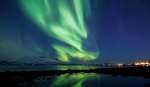 Flowing Auroras Over Norway
9.06.2013
Have you ever seen an aurora? Auroras are occurring again with increasing frequency. With the Sun peaking at its eleven year maximum in aurora-triggering activity, it is exhibiting a greater abundance of sunspots, flares, and coronal mass ejections.
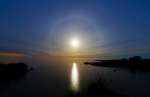 A Super Moon s Halo
28.06.2013
A Full Perigee Moon rose as the Sun set last Sunday. At its closest to Earth it was, by just a bit, the year's brightest and largest Full Moon also known as a Super Moon.
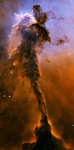 The Fairy of Eagle Nebula
29.09.2013
The dust sculptures of the Eagle Nebula are evaporating. As powerful starlight whittles away these cool cosmic mountains, the statuesque pillars that remain might be imagined as mythical beasts. Pictured above is one of several striking dust pillars of the Eagle Nebula that might be described as a gigantic alien fairy.
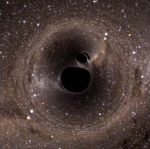 When Black Holes Collide
20.10.2015
What happens when two black holes collide? This extreme scenario likely occurs in the centers of some merging galaxies and multiple star systems. The featured video shows a computer animation of the final stages of such a merger, while highlighting the gravitational lensing effects that would appear on a background starfield.
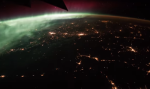 Flying Over the Earth at Night II
23.04.2021
Recorded during 2017, timelapse sequences from the International Space Station are compiled in this serene video of planet Earth at Night. Fans of low Earth orbit can start by enjoying the view as green and red aurora borealis slather up the sky.
|
January February March April May June July August September October |
|||||||||||||||||||||||||||||||||||||||||||||||||