
|
You entered: light
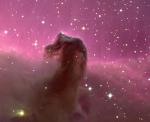 The Horsehead Nebula
19.05.1999
One of the most identifiable nebulae in the sky, the Horsehead Nebula in Orion, is part of a large, dark, molecular cloud. Also known as Barnard 33, the unusual shape was first discovered on a photographic plate in the late 1800s.
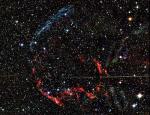 Galactic Supernova Remnant IC 443
21.07.1999
About 8000 years ago, a star in our Galaxy exploded. Ancient humans might have noticed the supernova as a temporary star, but modern humans can see the expanding shell of gas even today.
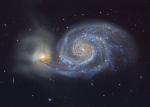 M51: Cosmic Whirlpool
10.07.2002
Follow the handle of the Big Dipper away from the dipper's bowl, until you get to the handle's last bright star. Then, just slide your telescope a little south and west and you'll likely find this stunning pair of interacting galaxies, the 51st entry in Charles Messier's famous catalog.
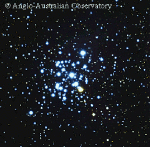 NGC 3293: A Bright Young Open Cluster
23.08.1996
Hot Blue stars shine brightly in this beautiful, recently formed galactic or "open" star cluster. Open cluster NGC 3293 is located in the constellation Carina, lies at a distance of about 8000 light years, and has a particularly high abundance of these young bright stars.
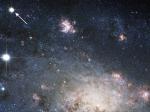 A Supernova in Nearby Galaxy NGC 2403
7.09.2004
The closest and brightest supernova in over a decade was recorded just over a month ago in the outskirts of nearby galaxy NGC 2403. Officially tagged SN 2004dj, the Type IIP explosion likely annihilated most of a blue supergiant star as central fusion could no longer hold it up.
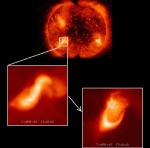 Sigmoids Predict Solar Eruptions
15.03.1999
On the Sun, S marks the spot. Solar explosions have been discovered to explode preferentially from regions marked with this letter. The surface of the quiet Sun is a maze of hot gas and flowing magnetic fields. When two regions of high magnetic field strength approach each other, they typically pass uneventfully.
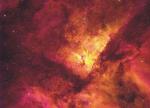 NGC 3372: The Great Nebula in Carina
19.07.1999
In one of the brightest parts of the Milky Way lies a nebula where some of the oddest things occur. NGC 3372, known as the Great Nebula in Carina, is home to massive stars and changing nebula.
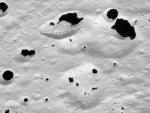 Iapetus in Black and White
14.09.2007
Iapetus, Saturn's third largest moon, is a candidate for the strangest moon of Saturn. Tidally locked in its orbit around the ringed gas giant, Iapetus is sometimes called the yin-yang moon because...
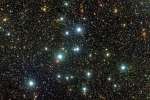 M39: Open Cluster in Cygnus
12.04.2009
Lying just at the limit of human perception is a picturesque starfield containing one of the larger open clusters on the northern sky. Spanning an angle larger than the Moon, M39's relatively few stars lie only about 800 light years distant toward the constellation of Cygnus.
 Himalayan Skyscape
4.12.2009
Capella, alpha star of the constellation Auriga, rises over Mt. Everest in this panoramic view of the top of the world at night. The scene was recorded in late November near Namche Bazar, Nepal, gateway to the Himalayan mountain range.
|
January February March April May June July August September October |
|||||||||||||||||||||||||||||||||||||||||||||||||