
|
You entered: light
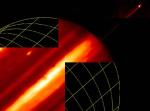 Jupiter: Moon, Ring, and Clouds
21.11.1997
An inner moon, an edge-on, planet-girdling ring, and high altitude cloud bands are visible in this mosaic of infrared images of gas giant Jupiter. The moon Metis, 25 miles wide and about 80,000 miles from the planet, is the bright spot at the upper right.
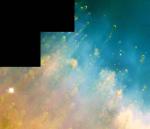 At the Edge of the Helix Nebula
12.05.2002
While exploring the inner edge of the Helix Nebula with the Hubble Space Telescope's Wide Field Planetary Camera 2, astronomers were able to produce this striking image - rich in details of an exotic environment.
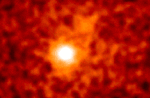 Gamma-Ray Quasars
23.10.1995
Gamma rays are more than 10,000 times more energetic than visible light. If you could "see" gamma rays, the night sky would seem very different indeed. The bright object in the center of the false color gamma-ray image above is quasar 3C279, a nondescript, faint, starlike object in the visible sky.
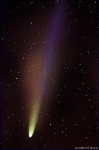 The Tails of Comet Hyakutake
2.05.1996
What makes comet tails so colorful? This photograph of Comet Hyakutake was taken the night of April 18th and highlights different components of the tail. The gold and red tail features are dust, made predominately of little bits of rock and carbon. The dust tail shines by reflecting sunlight.
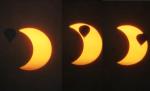 Sun, Moon, Hot Air Balloon
6.06.2003
Anticipating the celestial shadow play of a solar eclipse, sky gazers across Germany watched the Sun rise on May 31. In Bonn, astrophotographer Thilo Kranz had set up his small refractor telescope and camera on the Kennedy Bridge across the Rhein river to get a good view to the northeast.
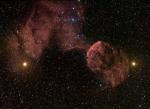 Elusive Jellyfish Nebula
8.04.2004
Normally faint and elusive, the Jellyfish Nebula is caught in the net of this spectacular wide-field telescopic view. Flanked by two yellow-tinted stars at the foot of a celestial twin - Mu and Eta Geminorum - the Jellyfish Nebula is the brighter arcing ridge of emission with dangling tentacles just right of center.
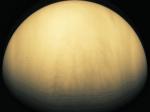 Venus: Earths Cloudy Twin
16.05.2004
This picture by the Galileo spacecraft shows just how cloudy Venus is. Venus is very similar to Earth in size and mass - and so is sometimes referred to as Earth's sister planet - but Venus has a quite different climate.
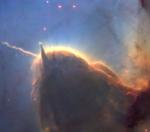 Trifid Pillars and Jets
8.06.1999
Dust pillars are like interstellar mountains. They survive because they are more dense than their surroundings, but they are being slowly eroded away by a hostile environment. Visible in the above picture...
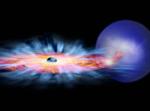 Wind from a Black Hole
1.07.2006
Binary star system GRO J1655-40 consists of a relatively normal star about twice as massive as the Sun co-orbiting with a black hole of about seven solar masses. This striking artist's vision of the exotic binary system helps visualize matter drawn from the normal star by gravity and swirling toward the black hole.
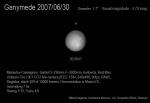 Astronomer s Moon
24.08.2007
Jupiter is an astronomer's planet -- its large size and contrasting global cloud belts and zones allow detailed studies with a range of earthbound telescopes. On the other hand, most telescopic views of Jupiter's moons usually show only featureless, tantalizing points of light hovering near the ruling gas giant.
|
January February March April May June July August September October |
|||||||||||||||||||||||||||||||||||||||||||||||||