
|
You entered: light
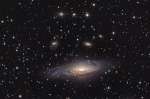 NGC 7331 and Beyond
24.10.2009
Big, beautiful spiral galaxy NGC 7331 is often touted as an analog to our own Milky Way. About 50 million light-years distant in the northern constellation Pegasus, NGC 7331 was recognized early on as a spiral nebula and is actually one of the brighter galaxies not included in Charles Messier's famous 18th century catalog.
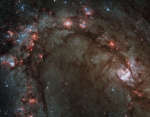 M83s Center from Refurbished Hubble
16.11.2009
What's happening at the center of spiral galaxy M83? Just about everything, from the looks of it. M83 is one of the closest spiral galaxies to our own Milky Way Galaxy and from a distance of 15 million light-years, appears to be relatively normal.
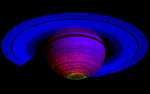 The Dancing Auroras of Saturn
27.09.2010
What drives auroras on Saturn? To help find out, scientists have sorted through hundreds of infrared images of Saturn taken by the Cassini spacecraft for other purposes, trying to find enough aurora images to correlate changes and make movies.
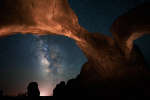 Three Arches Above Utah
24.05.2011
How many arches can you count in the above image? If you count both spans of the Double Arch in the Arches National Park in Utah, USA, then two. But since the above image...
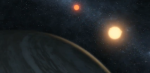 Kepler 16b: A Planet with Two Suns
20.09.2011
If you stay up long enough, you can watch both suns set. Such might be a common adage from beings floating in the atmosphere of Kepler 16b, a planet recently discovered by the space-based Kepler satellite. The above animated video shows how the planetary system might look to a visiting spaceship.
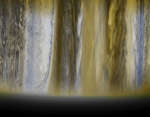 Jupiter's Clouds from New Horizons
23.10.2011
The New Horizons spacecraft took some stunning images of Jupiter on its way out to Pluto. Famous for its Great Red Spot, Jupiter is also known for its regular, equatorial cloud bands, visible through even modest sized telescopes.
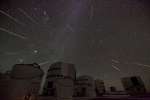 When Gemini Sends Stars to Paranal
15.12.2012
From a radiant point in the constellation of the Twins, the annual Geminid meteor shower rained down on planet Earth this week. Recorded near the shower's peak in the early hours of December...
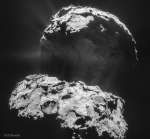 Comet 67P from Spacecraft Rosetta
2.02.2016
Spacecraft Rosetta continues to circle and map Comet Churyumov-Gerasimenko. Crossing the inner Solar System for ten years to reach the vicinity of the comet in 2014, the robotic spacecraft continues to image the unusual double-lobed comet nucleus. The featured image, taken one year ago, shows dust and gas escaping from the comet's nucleus.
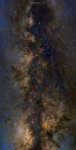 Great Rift Near the Center of the Milky Way
10.11.2016
Over 100 telescopic image panels in this stunning vertical mosaic span about 50 degrees across the night sky. They follow part of the Great Rift, the dark river of dust and molecular gas that stretches along the plane of our Milky Way Galaxy.
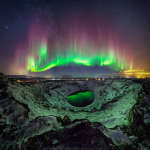 Colorful Aurora over Iceland
6.03.2017
You don't always see a scene this beautiful when you hike to an ancient volcano -- you have to be lucky. When the astrophotographer realized that aurora were visible two-weeks ago, he made a night-time run for the top of the caldera to see if he could capture them also reflected in the central lake.
|
January February March April May June July August September October |
|||||||||||||||||||||||||||||||||||||||||||||||||